








Phone:
0086 28 87573647
+86 19150187139

Permeate flux and desalination rate are key parameters in reverse osmosis (RO). In a RO system, pressure, temperature, recovery rate, feed water salinity, and pH all affect these parameters. How do these factors influence RO membrane performance?
1. Feed Water Pressure. Feed water pressure (the effective pressure to overcome osmotic pressure) affects the permeate flux and desalination rate of the RO membrane. Reverse osmosis technology overcomes natural osmotic pressure by applying operating pressure in the direction of feed water flow. When the operating pressure applied to the concentrate side is higher than the osmotic pressure, the natural flow direction of water molecules through osmosis is reversed, and the concentrate passes through the membrane to become purified water on the dilute side.
An increase in feed water pressure (the effective pressure to overcome osmotic pressure) has a linear relationship with an increase in the amount of water permeating the membrane. Since RO membranes cannot completely retain dissolved salts in the feed water, as the pressure increases, the rate at which water permeates through the membrane is faster than the rate at which salts are transferred, and the desalination rate gradually increases. However, there is an upper limit to increasing the salt removal rate by increasing the feed water pressure. Once a certain pressure value is reached, the desalination rate will no longer increase. In summary, as the feed water pressure increases, the water flux through the membrane also increases, and the desalination rate will increase to some extent. However, once a certain level of desalination rate is reached, it will not change further.
2. Temperature. Reverse osmosis membrane systems are very sensitive to changes in feed water temperature. Increased feed water temperature leads to a decrease in the viscosity of water molecules permeating the membrane and an increase in their diffusion capacity. Therefore, as the water temperature increases, the water flux increases almost linearly, and the salt permeation rate also accelerates. Thus, the higher the feed water temperature, the greater the permeate flow, but the lower the desalination rate. Conversely, the lower the water temperature, the smaller the permeate flow, but the higher the desalination rate. This explains why RO products experience a decrease in permeate flow and an increase in wastewater volume in winter, but the effluent quality is relatively higher (increased desalination rate).
3. Salt concentration (raw water TDS value). The salt concentration of the feed water affects osmotic pressure, which is a function of the concentration and type of salt or organic matter in the water. Increased salt concentration leads to increased osmotic pressure (which offsets the feed water pressure). With a constant permeate flow rate, the feed water drive to reverse the natural osmotic flow direction must also increase accordingly. When pressure remains constant, higher feed water salt content reduces flux and increases the salt flux permeating the membrane (reducing the desalination rate).
4. Recovery rate (wastewater ratio). If the recovery rate increases (with constant feed water pressure), the residual salt content in the raw water will be higher, and the natural osmotic pressure will continuously increase until it matches the applied pressure. This will offset the driving effect of the feed water pressure, slowing down or even stopping the reverse osmosis process. This also significantly increases the tendency for salts to precipitate on the membrane surface, leading to scaling problems. Therefore, increased recovery rate reduces permeate flow rate and desalination rate.
5. pH value. pH value affects reverse osmosis membrane elements in two ways: first, its impact on the desalination rate during normal membrane system operation; second, its impact on the cleaning effect during cleaning. Reverse osmosis membranes achieve their highest desalination rate at around pH 7, and the salt permeability of the membrane system increases with changes in pH. However, excessively high or low pH values can damage the membrane.
The following table illustrates the impact of the above indicators on RO membrane performance:
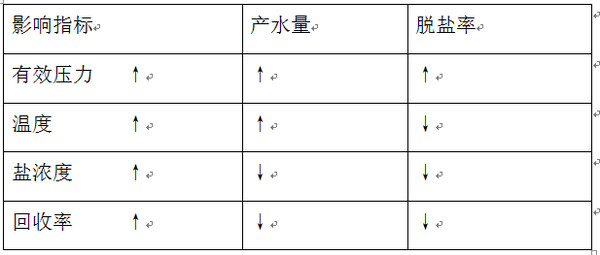
↑ indicates an increase, ↓ indicates a decrease.
A thorough understanding of the impact of other parameters on the performance of the reverse osmosis membrane within the system allows us to design our reverse osmosis system more scientifically and minimize the adverse effects of these factors on the membrane during actual use.





