



Phone:
0086 28 87573647
+86 19150187139

Many consumers believe that the wastewater generated by ultrapure water systems is wasteful. So why do ultrapure water systems produce wastewater? Are there any ultrapure water systems that don't produce wastewater?
A crucial process in ultrapure water systems is the RO (reverse osmosis) membrane. It's a key step in water treatment, and the wastewater generated during the process originates from this step.
The working process of a reverse osmosis membrane is essentially a liquid concentration process. As water flows over the membrane surface, the salt content increases, and the osmotic pressure also increases. When the osmotic pressure reaches the pressure of the booster pump, water can no longer pass through the membrane to the purified water side. Furthermore, due to the increasing mineral concentration in the water, some minerals (such as calcium carbonate, calcium sulfate, and silicon) deposit on the membrane surface, clogging the pores and leading to a decrease in water production and desalination rate (the membrane's ability to remove salts from water).
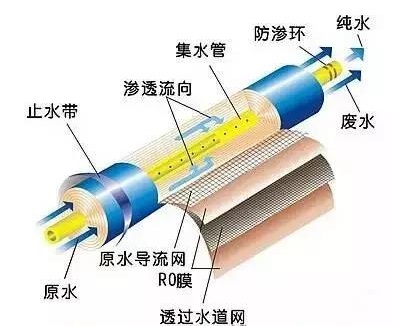
To avoid the above phenomena, all applied reverse osmosis membranes have a ratio that can convert feed water into product water, called the "recovery rate." Recovery rate = Product water volume ÷ Feed water volume × 100%.
A high water production rate in an ultrapure water machine means that its reverse osmosis membrane system has a high recovery rate. All reverse osmosis water purification equipment should have a reasonable recovery rate; any product exceeding this reasonable value comes at the cost of reduced reverse osmosis membrane lifespan.
Currently, there are three commonly used solutions on the market. Let's analyze their feasibility:
1. Recirculating wastewater back to the inlet of the reverse osmosis water purification equipment.
If the wastewater from the reverse osmosis water purification equipment is recirculated back to the inlet, only salt will flow into the system, and no salt will be expelled. This means that the salt content of the water inside the reverse osmosis water purification equipment will increase rapidly, eventually causing the osmotic pressure to exceed the pressure provided by the booster pump, resulting in the reverse osmosis water purification equipment failing to produce water. Simultaneously, due to the increased salt content, some sparingly soluble minerals begin to deposit on the membrane surface, leading to clogging and damage to the reverse osmosis membrane. This damage is usually irreversible, requiring replacement of the reverse osmosis membrane.
2. Timed, Intermittent Wastewater Discharge
Many products on the market operate reverse osmosis water purification equipment for a few minutes, then discharge wastewater for tens of seconds. This method is also unacceptable. During the periods when the reverse osmosis water purification equipment does not discharge wastewater, the recovery rate of the reverse osmosis membrane is 100%. Currently, no reverse osmosis membrane in the world can achieve a 100% recovery rate. The result of this is that trace amounts of sparingly soluble salts in the water rapidly deposit on the membrane surface, leading to clogging and severely shortening the membrane's lifespan. With this type of equipment, the reverse osmosis membrane typically becomes clogged within about a month and must be replaced. A properly designed system typically has a reverse osmosis membrane lifespan of about 3 years.
3. Storing Wastewater for Other Uses
This method involves storing wastewater in a large pressure tank and releasing it for use only when needed. This method is currently the only feasible one because it does not substantially change the operating parameters of the reverse osmosis water purification equipment.