








Phone:
0086 28 87573647
+86 19150187139

On June 1, 2017, US President Trump announced the US withdrawal from the Paris Climate Agreement, four days before World Environment Day on June 5. The Paris Climate Agreement, with 194 participating countries, was the result of tireless efforts by people around the world to save the planet and protect humanity's home. It was the third landmark international legal text in human history addressing climate change, following the 1992 United Nations Framework Convention on Climate Change and the 1997 Kyoto Protocol, thus establishing a global consensus on addressing climate change. Of course, the agreement was also the result of intense negotiations between developed countries, represented by the US, the EU, and Japan, and developing countries, represented by China and India.
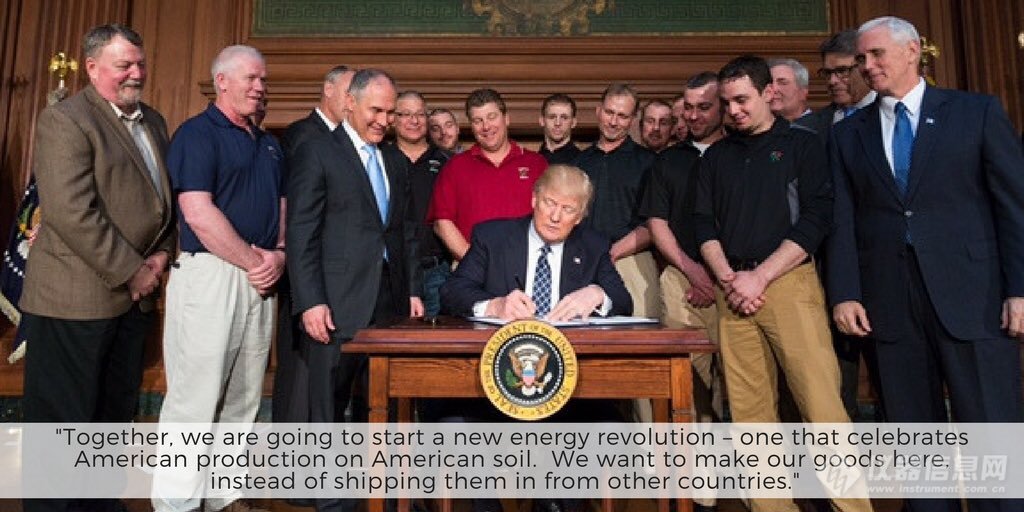
On World Environment Day, a colleague asked me, "Aren't you going to make a splash today?" This suggestion reminded me to analyze the potential impact of this "shocking" move (a major event in the environmental field) by the US president, a businessman by profession, on the instrument market. On March 28th of this year, Trump signed an executive order on energy independence at the Environmental Protection Agency, witnessed by more than a dozen representatives of American miners. This order aimed to overturn former President Obama's Clean Energy Plan on climate change and, in the energy sector, planned a large-scale return to mining and using traditional energy sources such as coal. Trump believed the Paris Agreement would affect the revival of traditional American industries and impact his massive infrastructure development and full employment plans.
A quick internet search revealed that the United States is actually the world's largest coal reserve holder. The US has proven coal reserves accounting for approximately 27% of the global total, about twice that of China, which ranks third. Although China's coal reserves are only 12.8% of the global total, it produces and consumes about half of the world's coal. Furthermore, China is the world's largest importer of coal. Why is coal currently China's primary energy source? Besides its large reserves, another simple reason is that it is cheap. Relevant data shows that among all fossil fuels, coal is the cheapest. For the same calorific value, the cost of coal is only 30% of that of oil and 40% of that of natural gas. Naturally, as a businessman, Trump is certainly aware of this economic calculation. Trump believes coal is America's "golden rice bowl," enabling the US not only to achieve energy self-sufficiency but also to become the world's largest producer of natural gas, oil, and coal. If these underground resources are fully utilized, they could bring the US at least $50 trillion in revenue. Currently, although the US possesses the world's largest coal reserves, its coal exports in 2016 were less than a quarter of those of Australia or Indonesia.
Undoubtedly, once President Trump's plan to revive the "long-damaged" US coal industry is implemented, the first sector to be "ignited" in the scientific instrument market will likely be those specializing in coal quality testing instruments. Secondly, once the abundant underground coal resources of the US are extracted, how to utilize these resources beyond exports is also a matter of great interest to the outside world. The US coal industry has been declared by the media to be "headed for the end," with strict local environmental regulations being a significant factor. Therefore, how to utilize coal resources more cleanly while effectively controlling costs is likely to be a new challenge for President Trump (unless, of course, it's only for export and not for large-scale domestic use). In short, whether the air in the US will remain fresh and clean in the future, and how much the closely related gas environment monitoring instrument market will benefit from the multi-party power struggles arising from this event and President Trump's "what ifs come after me" approach, remains to be seen and requires further observation.





