





Phone:
0086 28 87573647
+86 19150187139

With the increasing prevalence of ultrapure water equipment and the ever-evolving demands of science and technology, the requirements for ultrapure water are becoming increasingly stringent. Different applications of ultrapure water lead to different performance indicators. Therefore, in addition to resistivity, standards for measuring ultrapure water quality also include TOC (Total Organic Carbon), bacteria, and endotoxins.
Organic matter is a significant component of water contaminants. Total Organic Carbon (TOC) refers to the total amount of carbon present in water in various organic forms, including organic matter easily oxidized by common strong oxidants and organic matter requiring special oxidation methods. TOC is a key indicator for quickly assessing the quality of ultrapure water. TOC detection methods include online and offline monitoring. The basic principle is to oxidize organic matter in the water into carbon dioxide, and then detect the carbon dioxide.
The Sievers 500 RL online TOC analyzer is used for continuous monitoring of organic matter in ultrapure water, providing excellent analytical accuracy and performance. Its oxidation method is ultraviolet oxidation, which has the advantages of being reagent-free, free from catalyst poisoning, and simple to maintain. The detection method uses a breathable membrane, allowing only carbon dioxide to selectively pass through, effectively preventing interference from other substances in CO2 measurement and ensuring accurate quantitative analysis of various organic compounds.
Online TOC detection allows for intuitive and rapid real-time measurement of water samples, displaying results promptly. This effectively avoids many problems associated with offline detection, such as the influence of factors like the sampling process, sampling container, and sampling environment, resulting in more accurate, reliable, and reasonable data.
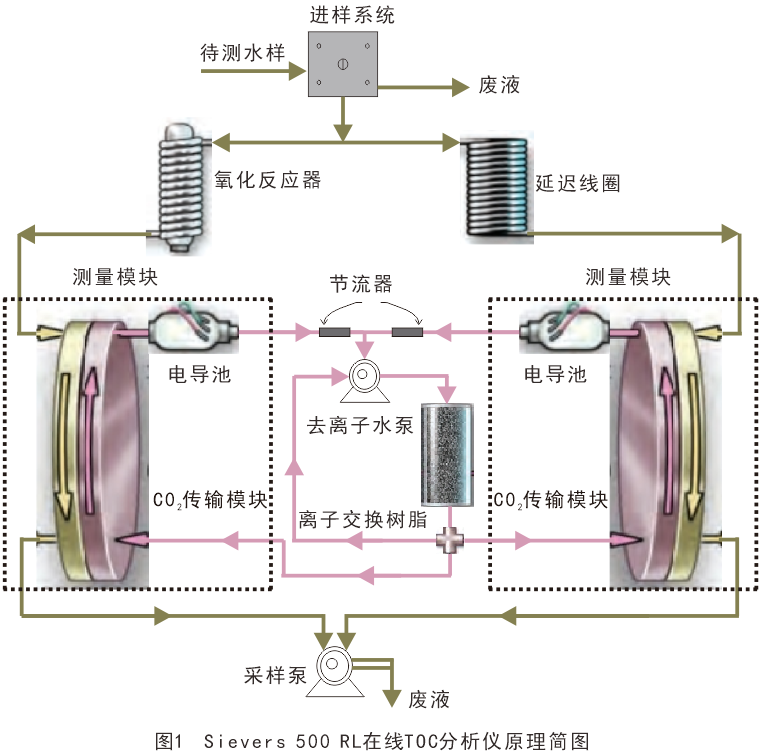
The Sievers 500 RL online TOC analyzer provides continuous monitoring. After receiving the water sample, the intelligent separator divides the sample stream into two equal parts: one part is used to measure IC (Inorganic Carbon), and the other part is used to measure TC (Total Cubic Carbon). The concentration of organic compounds equals the concentration of total carbon minus the concentration of total inorganic carbon.
The water sample to be tested enters a spiral quartz coil (oxidation reactor) wrapped around a UV lamp. The UV lamp emits ultraviolet light at 185nm and 254nm, forming strong oxidants in the form of hydroxyl radicals generated by water photolysis: H₂O + UV (185nm) → OH⁻ + H⁻
The hydroxyl radicals (OH⁻) completely oxidize organic matter, converting carbon atoms in the organic matter into CO₂: Organic compound + OH⁻ → CO₂ + H₂O
If the water sample does not require oxidation treatment, it passes through a delay coil, ensuring that the total flow time of the IC flow path through the analyzer is equal to the flow time of the TC flow path.
When the TC flow path exits from the oxidation reactor and the IC flow path exits from the delay coil, they flow to their respective CO₂ transfer modules. A CO₂ selective permeation membrane separates the analyzer's sample circuit from the deionized water circuit. CO₂ in the sample passes through the membrane and enters the deionized water, while interfering compounds and other oxidation byproducts are blocked by the membrane and remain on the sample circuit side. CO2 reacts with deionized water to produce carbonic acid, which decomposes into HCO3- and H+: CO2 + H2O ←→ H2CO3 ←→ H+ + HCO3-
Deionized water is continuously pumped through the analyzer's deionized water circuit. Simultaneously, H+ and HCO3- ions, as well as H2CO3 and CO2 molecules, are collected from the CO2 transfer module and sent to their respective conductivity cells for measurement. The change in conductivity during this process characterizes the CO2 concentration. The concentrations TC and IC are calculated using the conductivity readings. After obtaining the measured values: TOC = TC - IC. Then, the ion exchange resin in the deionized water circuit removes HCO3- and H+; the water sample is then pumped out of the instrument.
UPU Ultrapure Technology Co., Ltd. (UPU), as a professional manufacturer of ultrapure water instruments, shares the same pursuit of scientific advancement as our customers. Adhering to the principles of professionalism, innovation, excellence, and service, we are committed to supporting our customers at every step. To control product quality, we have introduced the Sievers 500 RL online TOC analyzer. We rigorously conduct TOC testing on the water produced by our equipment before it leaves the factory, and regularly perform TOC analysis on our pure water, EDI water, and deionized water to ensure the stability of water quality at every stage. We provide high-quality ultrapure water products to our customers.





