






Phone:
0086 28 87573647
+86 19150187139

In the process of treating pure water in an ultrapure water system, wound filter cartridges are often used as filtration consumables. So what are the characteristics and principles of wound filter cartridges?
When manufacturing wound filter cartridges, specially made roving with fluffy fibers is cross-wound onto a porous frame, layer by layer, to the required diameter. The roving continuously cross-wound onto the frame, forming a filter layer containing thousands of diamond-shaped pores. The diamond-shaped pores on the filter layer near the frame are small, increasing in size towards the outside, with the outermost layer having the largest pores. These pores connect internally and externally, forming channels. To increase the flow of liquid within the filter cartridge, the diamond-shaped pore channels are curved and radiating, but the layers of diamond-shaped pores remain interconnected. The curvature lengthens the diamond-shaped pore channels, effectively increasing the thickness of the filter layer and improving the filtration effect. This is the essence of deep filtration in filter cartridges (the yarn is wound with specific parameters, forming curved diamond-shaped filtration channels that decrease in size from the surface to the inside). The size of the innermost diamond-shaped pores in a filter element is crucial in determining its precision. Smaller pores result in higher precision, while larger pores lead to lower precision. Reputable filter manufacturers maintain specific tables showing the correlation between filter element precision and the number of diamond-shaped pores; different numbers of channels represent different levels of precision. Typically, an 8-channel filter has a precision of 100μm, a 15-channel filter has a precision of 20μm, and a 19-channel filter has a precision of 10μm. Wire-wound filter elements allow for high flow rates while maintaining excellent filtration performance even under relatively low pressure differentials due to their dispersed flow structure. This design also facilitates the removal of colloidal or gel-like substances from liquids. Because wire-wound filter elements can filter out particles much smaller than their pore size using relatively large pores, they are often referred to as precision filter elements.
Detailed Explanation of the Characteristics and Principles of Wound Filter Cartridges for Ultrapure Water Systems
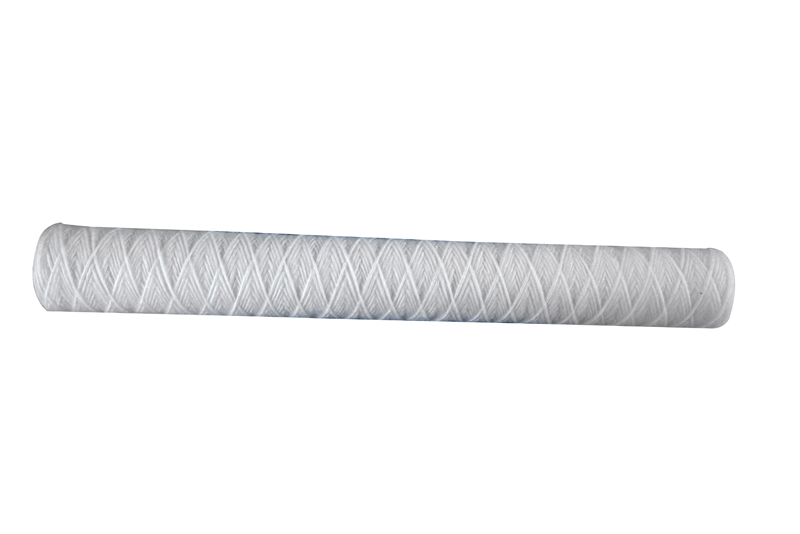
In addition to the interception effect of the pore grid formed by the overlapping and cross-stitched fibers of the filter cartridge, the filtration of wound filter cartridges also includes the hooking effect of the fibers on the channel walls and the deposition of particles within the channels.
1. Hooking effect of fibers on the filter cartridge channel walls: Liquid flows from the outer layer of the filter cartridge through a narrow, long, and tortuous channel into the inner layer. The channel walls are covered with curled fibers that hook and retain particles in the liquid within the channel.
2. Deposition of particles within the filter cartridge channels: The narrow, long, and tortuous channels of the filter cartridge cause the liquid to repeatedly impact the channel walls as it flows through at a certain speed. Particles in the liquid gradually deposit within the channel, similar to sludge settling down in a river bend.
3. Filtration principle: The liquid to be filtered is forced into the filter at the inlet, passes through the filter cartridge from the outside to the inside, and is filtered into a clear liquid before being discharged through the outlet. Impurities are trapped deep within and on the surface of the filter element, thus achieving the purpose of liquid filtration. The liquid first enters the lower part of the filter housing through the inlet pipe, then flows from the outside to the inside of the filter element. Larger particles immediately settle and are released through the drain valve, while smaller particles are intercepted by the filter element. Finally, the clean liquid is collected in the filter element tray and flows out through the outlet pipe. The liquid to be filtered flows into the wound filter element, then is distributed inside the filter element, undergoing filtration, demulsification, water molecule growth, and aggregation. After filtration, the liquid flows out from the outlet, impurities are trapped inside the filter element, and the aggregated water droplets settle in the sedimentation tank and are discharged through the drain valve.
1. When using dust collector filter elements (PP filter elements, wound filter elements), prevent particulate matter from entering the filter element and clogging or jamming the system.
2. After a period of use, the filter element should be maintained and serviced.
3. Regular cleaning is also necessary. After prolonged use, a large amount of impurities or other contaminants will accumulate in the system, requiring cleaning to ensure the filter element performs at its best.
4. The filter paper must always be kept moist, avoiding dryness, to extend its service life and maintain filtration accuracy.
5. Through fiber filtration, dust easily enters the dust collector within the filter element. Backflushing removes sticky substances from the filter cartridge, without affecting its filtration efficiency, thus better protecting the environment and maximizing its service life.





