







Phone:
0086 28 87573647
+86 19150187139

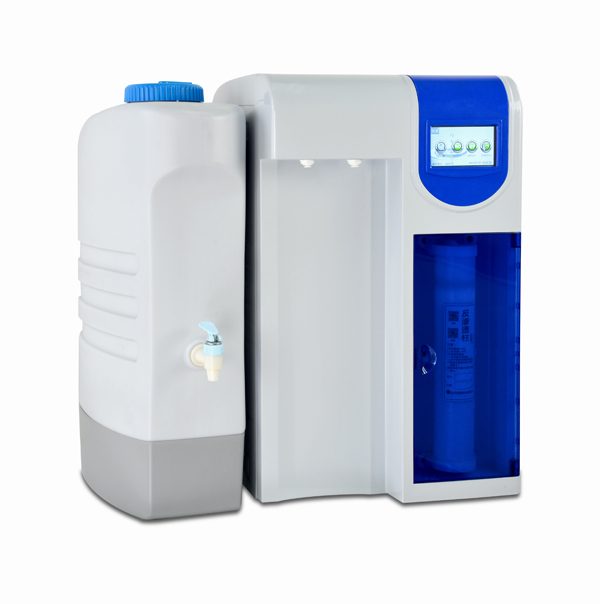
Customers using laboratory ultrapure water systems (ultrapure water machines) often encounter water quality problems, such as pH issues with their ultrapure water. Why does ultrapure water, which should be pH neutral, show results that are acidic (or alkaline)? What exactly is wrong with the water quality?
Typically, we use 18.2 MΩ·cm to indicate that ultrapure water has reached its limit of purity. At this point, the only conductive cations and anions remaining in the water are 1*10⁻⁷ M of [H⁺] and [OH⁻]. The acid-base change resulting from carbon dioxide to carbonic acid at this stage becomes very interesting. First, although the concentration of carbon dioxide in the air is only 0.035% (350 ppm), it can still undergo a chemical change with water, as follows: CO2(g) + H2O(l) <-----> H2CO3(l)
Although carbonic acid is a weak acid (Ka1 = 4.3 × 10⁻⁷), since there are no dominant relatively strong acids, strong bases, conjugate acids, or conjugate bases in ultrapure water, carbonic acid is the only dominant weak acid and the only source of [H⁺] ions (ignoring the dissociation of H₂O).
Ka1 = [H⁺][HCO₃] / [H₂CO₃] = 4.3 × 10⁻⁷
If needed, we can simulate the carbon dioxide → carbonic acid → carbonate ion reaction in the laboratory. When ultrapure water is exposed to the atmosphere, the dissolution of carbon dioxide inevitably continues. We can monitor this process using two methods.
1. Conductivity will continuously increase. Typically, within one hour, conductivity will rise from 0.055 μS/cm (18.2 MΩ·cm) to above 0.25 μS/cm (below 4 MΩ·cm), during which the total ion concentration in the water will increase by more than 4.5 times.
2. pH will begin to decrease continuously from 7 (neutral). Within approximately one hour, the pH value will drop to 5.7, and will continue to gradually decrease to around 4.7 (taking about two days), with few exceptions.
Of course, given this irreversible phenomenon, ultrapure water must be used immediately after collection. Prolonged storage in any way, besides contamination from containers and open-air environments such as dust, volatile organic compounds, and microorganisms, will inevitably lead to an increase in conductivity and a decrease in pH due to carbon dioxide.
It's particularly important to note that using a standard pH meter to measure ultrapure water produces highly unstable readings for the following reasons:
1. Standard pH meters are designed for high ionic strength solutions, while ultrapure water is an extremely low ionic strength solution. In fact, there are electrodes and highly sensitive instruments on the market specifically designed for low ionic strength solutions. If these types of instruments are not used, the readings will fluctuate wildly, making them very difficult to interpret.
2. Clogged salt bridges (synonyms: salt bridge/diaphragm/junction, etc.) cause functional loss, often due to lack of electrode maintenance. Salt bridges are usually made of porous ceramic or Teflon materials, primarily used for balancing cations and anions inside and outside the electrode. However, due to lack of regular cleaning, the measured pH of ultrapure water is often unreasonably high, mostly around 9-11, even in low ionic strength solutions. In such cases, adding a small spoonful of neutral salt (KCl) to improve ion diffusion on the salt bridge rarely results in the pH dropping below 7 within seconds. Theoretically, neutral KCl does not change the pH; it only changes the ionic strength.
3. Common problems with laboratory pH meters include: (a) Expired pH standard solutions. (b) When not in use, ensure the electrode is immersed in a 3M KCl solution. (c) The reference electrode solution inside the electrode must be changed frequently; otherwise, a series of problems will occur.
Therefore, the conclusions are as follows:
1. Essentially, measuring the pH of ultrapure water cannot prove its quality. Within the pH range affected by carbon dioxide (pH 7 → pH 4.5), any pH reading only indicates the degree of carbon dioxide dissolution and carbonic acid dissociation; it has no other significance.
2. If the pH reading is alkaline, it may indicate a problem with the electrode (electrode membrane contamination or aging, salt bridge blockage, reference solution contamination, etc.). Measuring the pH of ultrapure water is equivalent to operating the pH meter under extreme conditions, which is extremely challenging for its capabilities.
3. UPU engineers do not recommend using pH meters to prove water quality because too many factors are involved. Therefore, testing the conductivity of ultrapure water using an air-free, online method is the most accurate and stable approach. This can be proven experimentally and chemically. Water with a conductivity of 18.2 MΩ·cm will definitely have a total anion/cation ratio below 1 ppb (refer to technical literature), which is sufficient to meet water quality standards.
The above information regarding pH in laboratory ultrapure water equipment was compiled by the marketing department of Sichuan Youpu Ultrapure Technology Co., Ltd., to clear up any doubts you may have. If you still have any questions, please feel free to call our 24-hour nationwide customer service hotline at 400-884-6567.





