Phone:
0086 28 87573647
+86 19150187139

Xiao Xiulin, Zhu Liwei (Zhejiang Electric Power Research Institute, Hangzhou 310014, Zhejiang, China)
Abstract: Electro-deionization (EDI) systems have been widely used in the electronics and pharmaceutical industries, but their application in the power industry is still relatively limited. This article presents an experimental study on the operation of an EDI system in a water treatment system, obtaining operation and maintenance data, and providing some experience for the application of EDI in power systems.
Keywords: Electro-deionization (EDI); Operation; Maintenance; Chemistry; Experimental study
CLC Number: TM621.8
Document Code: B
Article Number: 1007-1881(2004)05-0028-04
Received Date: 2004-07-05
Author Biography: Xiao Xiulin (born 1970), male, from Honghu, Hubei Province, senior engineer, master's degree, engaged in power plant chemical technical services and research on new water treatment technologies. Introduction
Electrodeionization (EDI) technology effectively integrates electrodialysis and ion exchange technologies. It is a novel water treatment method that uses mixed-bed resin filled between ion exchange membranes to achieve continuous desalination under a direct current electric field. It combines the advantages of continuous desalination in electrodialysis and deep desalination in ion exchange, while avoiding the concentration polarization problems of electrodialysis and the acid-base regeneration issues of ion exchange. Originating in the 1950s, this technology achieved breakthroughs in the 1990s amidst rapid industrial development and is now widely used in electronics, pharmaceuticals, energy, and laboratories, showing promise as a mainstream water treatment technology in the future.
This paper primarily investigates the pre-desalinated water at the reverse osmosis outlet of Zhejiang Jiaxing Power Generation Co., Ltd. through an operational test of the EDI system. It examines whether the pre-decarbonized water at the power plant's reverse osmosis outlet can meet boiler water quality requirements after EDI treatment. This study also provides relevant data and experience for the operation and maintenance of EDI systems in power generation.
EDI Principle
EDI is also known as packed bed electrodialysis in my country. The desalination chamber of the electrodialysis unit is filled with a mixture of anion and cation exchange resins (granules, fibers, or woven fabrics), allowing the electrodialysis and ion exchange processes to be carried out in the same container, thus linking the two processes internally.
It is generally believed that the principle of EDI can be divided into three aspects horizontally: ion exchange, selective migration of ions under a DC electric field, and electroregeneration of resin [1]. In high-purity water, the conductivity of ion exchange resin is 2-3 orders of magnitude higher than that of the water in contact with it, so almost all ion migration from the solution to the lipid surface is accomplished through the resin. Ions in the water are first adsorbed onto the resin particles due to exchange, and then migrate to the membrane surface through the ion propagation channels formed by the resin particles under the action of an electric field, and enter the concentrate chamber through the ion selective membrane. At the same time, at the interface where the resin, membrane, and water are in contact, the polarization in the interfacial diffusion causes the water to dissociate into hydrogen ions and hydroxide ions. Besides participating in the load current, most of them also play a role in regenerating the resin, thus enabling the three processes of ion exchange, ion migration, and electroregeneration to occur simultaneously and promote each other, achieving continuous deionization.
Vertically, the EDI process can be divided into three parts from the influent side to the product water side. The part closer to the influent side is called the saturation zone, where the filled resin has already undergone ion exchange with the ions in the influent. The part closer to the effluent side is called the regeneration zone, where most of the ions in the effluent have been removed, and a small number of weakly ionized ions are removed. Simultaneously, pure water is ionized in this zone, and the generated H+ and OH- regenerate the filled resin. The area between the saturation zone and the regeneration zone is called the working zone, where ion exchange and electroregeneration tend to reach equilibrium.
Characteristics of EDI Technology
In chemical desalination systems, ion exchange devices have evolved from single-stage mixed beds to two-stage mixed beds, and finally to mixed beds. Using ion exchange, high-purity water with a resistivity close to the theoretical pure water of 18.2 MΩ·cm can be produced. However, the advantage of ion exchange resins being repeatedly regenerable brings the waste acid and alkali from resin regeneration, causing environmental pollution. To overcome this pollution, reverse osmosis technology was introduced into water desalination systems, namely reverse osmosis + mixed bed desalination systems. Compared with ion exchange desalination systems, the waste acid and alkali discharge is reduced by 90%, essentially solving the problem of waste acid and alkali discharge. However, with increasing process requirements, this method has revealed two drawbacks: mixed bed regeneration requires the storage of acid and alkali, and operation is cumbersome. With the development of EDI technology, replacing mixed beds with EDI equipment to form RO-EDI desalination systems can overcome pollution and achieve automated pure water production.
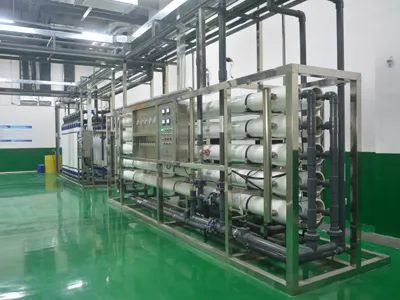
Characteristics of RO-EDI desalination systems: no acid or alkali is used, no environmental pollution; continuous production is possible, no backup equipment is needed; unattended operation, stable water quality; small footprint, low operating costs; special requirements for the influent water of RO and EDI equipment.
System Process Flow Selection
Currently, the chemical makeup water supply system of Jiaxing Power Generation Co., Ltd. consists of a single-stage RO system and a two-stage ion exchange desalination system. Therefore, this operational test adopted a combination of a single-stage RO system and an EDI system. The specific process flow is as follows:
Single-stage RO → Pre-deionized water tank after reverse osmosis → Booster pump → Decarbonizer → EDI booster pump → EDI module → Effluent
Since the pre-deionized water after reverse osmosis contains free CO2, a CO2 decarbonizer was installed before the EDI module to reduce the load on the EDI module.
Data Statistics of the EDI System Start-up Phase
The data from the start-up phase shows that, with the voltage remaining constant, both the system current and the resistance of the effluent increase.
Figure 3. Voltage, current, influent conductivity, and product water resistivity during EDI startup.
As a novel water treatment technology, EDI's system characteristics and technical maintenance have always been a focus of research. The following analysis examines the main factors affecting EDI system operation, including influent conductivity, influent flow rate, voltage and current, water pH, temperature, and pressure.
The Influence of Influent Conductivity on Desalination Effect
Under the premise of keeping other conditions constant, the desalination effect deteriorates as the raw water conductivity increases. This is because when the influent conductivity exceeds a certain range, the module's working range shifts downwards, even disappearing, and the working range is penetrated, resulting in most of the resin filling the module being saturated and ineffective. Simultaneously, the ion concentration in the water increases. With a constant voltage, the current increases, thus weakening the water ionization process. Consequently, the amount of H+ and OH- ions generated by water ionization decreases, directly leading to poorer resin regeneration. Thus, when the influent water quality deteriorates, the module will gradually penetrate starting with weakly charged ions; the system current will increase because of water ionization, and the current increase is non-linear under constant voltage.
Influence of Influent Flow Rate
The influent flow rate is related to the EDI module's processing capacity, influent water quality, and influent pressure. Under the condition of constant EDI module product water capacity, the worse the influent water quality, the heavier the unit processing load of the module, and the smaller the influent flow rate should be. During the module startup phase, care should be taken to avoid membrane perforation caused by excessive instantaneous flow rate.
Since the electron flow in the module is mainly transferred through the filling resin, the concentrate current becomes, to a certain extent, a key factor affecting electron migration in the module. Actual experiments show that reducing the concentrate flow rate can increase the system current and, to some extent, improve water quality. However, a lower concentrate flow rate is not always better. Too low a flow rate can lead to an excessive concentration difference across the membrane, resulting in concentration diffusion [2] and affecting water quality. Furthermore, because the solubility of weakly charged ions (Si) and their ionic compounds is very low, they easily become saturated in low-flow concentrate, thus affecting the removal of weakly charged ions. Based on field tests, a concentrate flow rate of approximately 5% to 10% of the influent flow rate is generally recommended.
The main function of electrode water is to cool the electrodes and remove gases generated on the electrode surface. Generally, the electrode water flow rate is about 1% of the influent flow rate. If the electrode water flow rate is too low, it cannot remove the gases from the electrode surface in time, affecting the operation of the entire module.
Influence of Voltage and Current
The voltage is related to the module design. Voltage is the driving force for ion migration, enabling ions to migrate from the influent to the concentrate. Voltage is also crucial for the regeneration of the resin using electrolyzed water. If the voltage is too low within the specified range, it will lead to a reduction in electrolyzed water, resulting in insufficient H+ and OH- ions to regenerate the filler resin. Simultaneously, the low voltage weakens the migration momentum of ions, ultimately causing the module's operating range to shift downwards, leading to a deterioration in the quality of the product water. If the voltage is too high, excess H+ and OH- will be electrolyzed, increasing the current and intensifying ion polarization and diffusion, resulting in a deterioration in the quality of the product water. Whether the voltage is too high can be judged by the number of bubbles in the electrode water outlet. The optimal voltage range is mainly determined by the influent conductivity and the concentrate flow rate. For example, when the influent conductivity increases and the concentrate concentration also increases, the system resistance decreases, so the system voltage should be adjusted accordingly.
The current is directly related to the influent conductivity and the total ion transport number [3]. Total ion migration includes existing ions in the water such as Na+ and Cl-, as well as newly generated H+ and OH-. H+ and OH- are directly related to voltage; therefore, as voltage increases, current also increases. However, the changes are not linear, as part of the current is used for the migration of impurity ions and part for the dissociation of water.
Influence of pH, Temperature, and Pressure of Influent
The pH of the influent indicates the H+ content in the influent, which is generally controlled between 5 and 9.5. A low pH is usually caused by the dissolution of CO2. Since CO2 is a weakly ionized substance, it is also one of the factors leading to water quality deterioration. Therefore, a decarbonization device is usually installed before entering the EDI system to control the CO2 in the water below 5 mg/L. There is a certain solubility relationship between pH and CO2 in water. Theoretically, the removal efficiency is optimal when pH > 10 [4]. The same principle applies to weakly ionized Si, because the pKi of silicic acid is 9.8. A high pH value helps remove weakly charged ions, but this requires that Ca²⁺, Mg²⁺, and other ions be removed before entering the EDI system.
Temperature directly affects system pressure and product water resistance. Generally, the feed water temperature for EDI should be controlled between 5 and 35°C, with the optimal temperature around 25°C. Lowering the temperature reduces water activity, meaning the Brownian motion of ions in the water weakens, macroscopically manifesting as increased water viscosity and higher system pressure. Another consequence of weakened ion migration is a reduced exchange rate between ions and the filling resin and membrane; concentration polarization becomes a bottleneck affecting the rate. Furthermore, the membrane's exchange capacity generally decreases with decreasing temperature. Conversely, if the temperature rises, the opposite phenomenon occurs. At this point, the activity of ions in the water increases, their movement becomes more vigorous, and the water's conductivity increases accordingly. If the given voltage remains constant, the current will increase. When the temperature exceeds a certain level, the quality of the product water gradually deteriorates. This is mainly due to the weakening of the exchange process between ions and the filling resin and ion exchange membrane, which is affected by ion activity. Therefore, when the inlet water temperature is low, we need to appropriately increase the voltage to increase the driving force of ion migration and more effectively ionize water molecules. Conversely, when using relatively high-temperature inlet water, we can achieve the same effluent water quality by reducing the voltage to save energy. Pressure variation and control are another important factor for the normal operation of the EDI module. Generally, the pressure of the product water > the pressure of the concentrate > the pressure of the electrode water. This effectively prevents the diffusion of concentrate and contamination of the product water. Pressure variation is also an effective means of determining whether the EDI module is contaminated or whether the pipeline is blocked [5]. Especially when the pressure difference between the concentrate inlet and outlet increases, a common problem is blockage in the concentrate pipeline. In this case, manual cleaning of the pipeline, chemical cleaning, or other methods are needed to reduce the pressure difference. Therefore, at the EDI system inlet, the contamination index of the inlet water should be kept within the acceptable range.
System Balance Assessment, Adjustment, and Maintenance
An EDI system maintains a balance during operation, where the total number of incoming ions equals the total number of outgoing ions. This is macroscopically manifested as relatively stable operating ranges across the three operating zones, without significant fluctuations. Changes in module operating conditions require a considerable amount of time to reach equilibrium.
Adjustable factors during system operation include influent flow rate, concentrate flow rate, and voltage.
Increasing the influent flow rate increases the module's operating pressure. If this pressure exceeds the EDI's processing range, the effluent quality will significantly deteriorate. Therefore, when the influent conductivity is high, appropriate adjustment of the influent flow rate is necessary. Conversely, when the influent conductivity is low, the influent flow rate can be increased within the EDI system's pressure tolerance range to improve permeability.
Changes in concentrate flow rate are another factor in maintaining system balance, particularly directly affecting the system's current. The concentrate flow rate also influences the removal of the weakly charged Si ion. Since the solubility of Si in water at 25℃ and a pH of 6-8 is 120 mg/L... Therefore, once the concentration ratio of the influent reaches a certain level, Si will become saturated in the concentrate, preventing deeper silica removal. This is one of the conditions for determining the lower limit of the concentrate flow rate.
If the voltage decreases or the total ion level of the influent increases, the resin in the system will exchange more ions, and the corresponding operating range will shift towards the effluent side until a new equilibrium is reached or breakthrough occurs. During this process, the conductivity of the effluent will change, with an increase in the amount of weakly charged ions in the effluent being the most obvious manifestation. If the voltage increases or the influent ion level decreases, the operating range of the system will shift towards the influent side, resulting in improved effluent quality and a decrease in the content of weakly charged ions. Therefore, the equilibrium state of the system can be determined by changes in effluent quality and the amount of weakly charged ions leaking out, which can be explained by the shift in the operating range.
Through the small-scale EDI experiment of the chemical desalination system at Jiaxing Power Generation Co., Ltd., we gained a lot of experience in the practical operation of EDI. The experiment shows that the conductivity of the influent, the applied voltage, the concentrate flow rate, and the water temperature are all important factors controlling the normal operation of the EDI module system. Coordinating and determining the relationships between various operating conditions according to actual conditions and local circumstances is also key to the application of EDI systems in power generation. It is conceivable that after properly addressing the above issues, EDI technology will leverage its advantages to occupy an important position in the future water treatment industry.