Phone:
0086 28 87573647
+86 19150187139

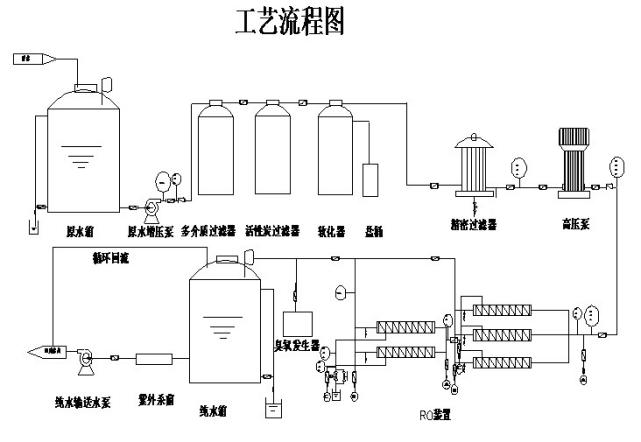
Pure water treatment involves many processes, and a pure water system also has its own corresponding treatment processes. Today, we'll summarize the basic processes of pure water equipment.
1. Coarse Filtration: This refers to mechanical filtration, removing suspended solids, colloids, turbidity, color, odor, etc., from the water. Main filtration methods include clarifiers, rapid filters, sand filters, sand filters, multi-media filters, activated carbon filters, disc filters, and high-efficiency fiber filters.
2. Fine Filtration: This uses filter membranes made of special materials, offering high filtration precision. Common types include microfiltration membranes and cartridge filters.
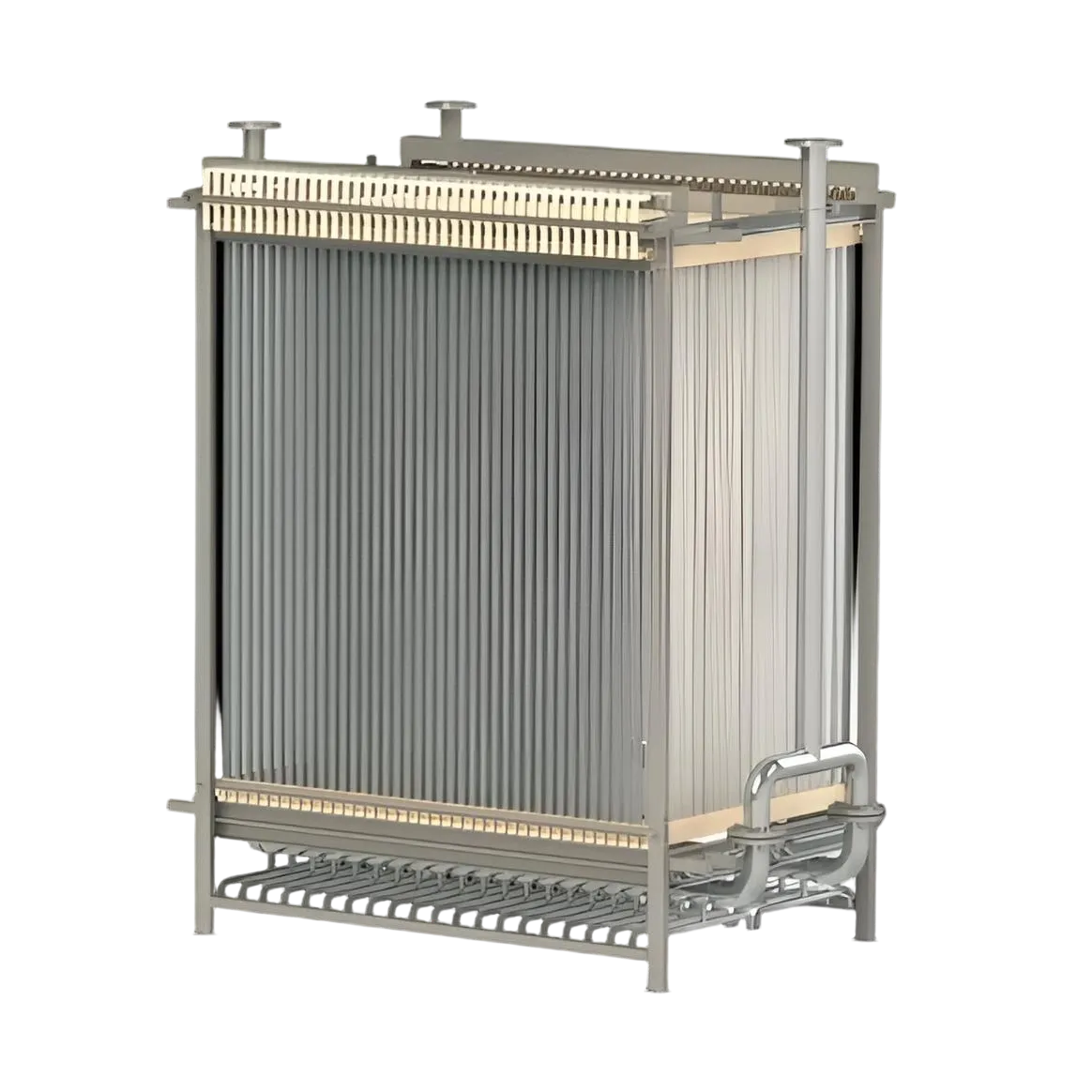
3. Ultrafiltration: This is a type of membrane filtration that removes large molecules, colloids, bacteria, etc. It offers high filtration precision, with ultrafiltration membranes being the most common. Ultrafiltration membranes cannot remove ions from the water, meaning they do not have desalination capabilities. They are used for pretreatment of reverse osmosis or fine treatment after reverse osmosis, and can also be used alone. Ultrafiltration is a tangential flow and pressure-driven filtration process that separates particles according to their molecular weight. The pore size of ultrafiltration membranes is approximately in the range of 0.002-0.1 micrometers. Dissolved substances and substances smaller than the membrane pore size can pass through the membrane as permeate, while substances that cannot pass through the membrane are concentrated in the effluent. Therefore, the product water contains water, dissolved solids, and low molecular weight substances, while colloids, suspended particles, high molecular weight organic matter, bacteria, viruses, and protozoa are filtered out.
4. Reverse Osmosis: Reverse osmosis, abbreviated as RO, is a membrane separation technology developed in the 1960s. Its principle is that raw water passes through a reverse osmosis membrane under high pressure, causing the solvent in the water to diffuse from a high concentration to a low concentration, thus achieving separation, purification, and concentration. Because it is the opposite of osmosis in nature, it is called reverse osmosis. Reverse osmosis can remove bacteria, viruses, colloids, organic matter, and more than 98% of dissolved salts from water. This method has the characteristics of low operating costs, simple operation, high degree of automation, and stable effluent quality. Compared with other traditional water treatment methods, it has significant advantages and is widely used in various industries related to water treatment. Reverse osmosis water treatment is essentially a physical desalination method, possessing several superior characteristics not found in traditional water treatment methods:
5. Ion Exchange: Various inorganic salts in water ionize to generate cations and anions. When these cations pass through a hydrogen-type ion exchanger layer, the cations in the water are replaced by hydrogen ions; this is the desalination principle of a cation bed. Similarly, various inorganic salts in water ionize to generate cations and anions. When these anions pass through an OH-type ion exchanger layer, the anions in the water are replaced by OH- ions; this is the desalination principle of an anion bed. A mixed bed is an ion exchange device in which cation and anion exchange resins are mixed in a certain proportion and packed into the same exchange column. The uniformly mixed resin layer, with cation and anion resins arranged closely and alternately, resembles a set of mixed beds, thus the mixed bed can be considered as an infinite number of mixed beds operating in series. Because hydrogen ions and hydroxide ions entering the water after mixed-bed ion exchange immediately form water molecules with very low ionization, the formation of counterions, which is unlikely during cation or anion exchange, allows the exchange reaction to proceed very thoroughly. Therefore, the effluent quality of a mixed-bed ion exchange system is superior to that of a combined ion exchange system consisting of cation and anion exchange cells in series, producing finished water with a considerably high purity.
6. EDI: EDI technology is a new desalination process that combines electrodialysis and ion exchange. This equipment combines the advantages of both electrodialysis and mixed-bed ion exchange, compensating for their respective shortcomings. It utilizes ion exchange for deep treatment without the need for chemical regeneration, using the H+ and OH- generated by ionization to regenerate the resin. EDI has high requirements for the influent water quality; it must be reverse osmosis permeate or water of equivalent quality. It has the following characteristics:
(1) It can continuously produce qualified ultrapure water that meets user requirements, with stable water production;
(2) It requires no chemical regeneration and has no chemical emissions, making it a green and environmentally friendly product;
(3) It has a compact structure, small footprint, and low water production cost;
(4) The device is debugged before leaving the factory, making on-site installation and debugging simple;
(5) It is easy to operate, with extremely low labor intensity and easy training.