







Phone:
0086 28 87573647
+86 19150187139

Which ultrapure water system is the best? That's hard to say. Why? Because each brand's products have their own advantages and disadvantages. As long as it's produced by a reputable manufacturer and meets your current needs, it's a good product. Products from counterfeit manufacturers are another story.
With the continuous development of technology, the demand for pure water for experiments is increasing, and the demand for laboratory ultrapure water systems is also increasing year by year. How to choose a reputable brand, high quality, reasonably priced ultrapure water system that meets the daily needs of the laboratory has become a pressing issue. Below are some points to consider when purchasing an ultrapure water system:
First, regarding budget: Before purchasing, consider your actual budget and choose a product that suits your needs to avoid overspending. Foreign brand ultrapure water systems are generally more expensive, usually about 50% more expensive than domestic brands. Counterfeit brands are cheaper, but the quality cannot be guaranteed. You can refer to my previous article, "Why Reputable Manufacturer Ultrapure Water Systems Are More Expensive Than Other Unofficial Brands," for more information.
Secondly, regarding the pure water process: After determining the budget and brand, the next step is to select the specific model. First, let's understand the current technology used in pure water machines.
Dispensing water purifiers have been largely abandoned by most laboratories because the water quality is not high, and the process is time-consuming, labor-intensive, and expensive, resulting in unsatisfactory laboratory results—a net loss. Currently, most laboratories use reverse osmosis technology, which produces water that meets national standards and is widely adopted. Moreover, the technology of domestically produced pure water machines is now comparable to that of major international brands; our technology is not inferior, and in some aspects, it is even superior.
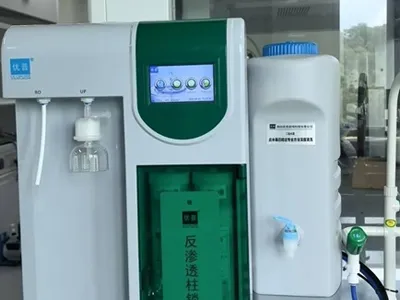
Thirdly, regarding local water quality requirements: After considering the above, we need to select the specific model of ultrapure water machine based on the local water quality conditions. For example, if your local water source is tap water, then the UPT and UPD series pure water machines will be sufficient; if your local water source is well water, then the UPR series will meet your needs.
Fourth, regarding application: After resolving the water source issue, you can consider your specific water needs. For example, do you primarily use pure water, ultrapure water, or both? In this case, you can choose a machine that outputs pure water, ultrapure water, or both.
Fifth, regarding water production capacity: Once the machine's purpose is determined, you can choose based on the laboratory's daily water consumption. Specific models range from 5L to 90L per hour. It's recommended to consult with sales personnel for a suitable model recommendation.
Sixth, regarding after-sales service: After confirming the above, don't rush to purchase. We need to consider a crucial question: what if there are any problems with the ultrapure water machine? Is there after-sales service to promptly resolve the issue? Which ultrapure water machine manufacturer is the best? Does this brand offer reliable after-sales service? These are all questions we need to consider before purchasing.
Generally speaking, foreign brands in China are mostly represented by distributors. After-sales service in these cases involves complex and lengthy application procedures, which may delay production. Domestic major brands, on the other hand, offer much more reliable after-sales service. For example, UPU has its own after-sales service centers in every province and region across China, ensuring timely resolution of any issues and preventing disruptions to production needs.
The above summarizes some tips for choosing an ultrapure water system, focusing on which brand is best. Hopefully, this will help you select the right product for your needs.





