





Phone:
0086 28 87573647
+86 19150187139

The much-anticipated Sichuan plan for the "Water Ten Measures" has finally been released.
On December 7th, reporters learned from the Sichuan Provincial Environmental Protection Department that the 103rd executive meeting of the provincial government recently reviewed and approved the "Sichuan Provincial Work Plan for the Water Pollution Prevention and Control Action Plan." By 2020, the province's water environment quality will see phased improvement. By 2030, efforts will be made to achieve overall improvement in the province's water environment quality and initial restoration of the aquatic ecosystem's functions. The black and odorous rivers that have been a major headache for residents will be gradually eliminated. By the end of 2017, Chengdu will have basically eliminated black and odorous water bodies, and by the end of 2020, other cities (prefectures) in Sichuan will have completed their black and odorous water body treatment targets.
Phased improvement in the province's water environment by 2020
"The 'Work Plan' is generally compiled according to the framework of the national 'Water Ten Measures,' combined with Sichuan's actual situation. It includes four parts: overall requirements, work objectives, main indicators, and key tasks, totaling 10 articles, 35 clauses, and 98 items," explained a relevant official from the Pollution Prevention and Control Division of the Sichuan Provincial Environmental Protection Department.
Reporters learned that Sichuan will implement a three-step approach to its work objectives. "By 2020, the province's water environment quality will see phased improvement. The quality of surface water bodies with good water quality will remain stable and improve, the number of severely polluted water bodies will decrease significantly, and the quality of general water bodies will steadily improve; the level of drinking water safety will continue to improve; the quality of groundwater will remain stable; and the water environment in key control areas of the Minjiang and Tuojiang River basins (Chengdu, Meishan, Leshan, Yibin, Deyang, Ziyang, Neijiang, Zigong, Luzhou, etc.) and the Jialing River basin (Mianyang, Suining, Nanchong, Guang'an, Dazhou, etc.) will continue to improve." By 2030, the province aims for overall improvement in water environment quality and initial restoration of aquatic ecosystem functions. By the middle of this century, the ecological environment quality will be comprehensively improved, and the ecosystem will achieve a virtuous cycle.
By the end of 2017, Chengdu will eliminate black and odorous water bodies.
How to ensure clean water in practice? Sichuan has proposed specific targets. By 2020, the proportion of excellent or good water quality at monitoring sections included in the national assessment of the five major river basins—the Jinsha River, Jialing River, the main stream of the Yangtze River (Sichuan section), the Min River, and the Tuo River—will reach over 81.61% overall; Class V or worse water bodies in the main streams and first-level tributaries of the Min River, Tuo River, and Jialing River will be basically eliminated; black and odorous water bodies in the built-up areas of each city will be controlled within 10%; the proportion of excellent or good water quality in centralized drinking water source protection areas of each city (prefecture) will be higher than 97.6%, and the proportion of excellent or good water quality in centralized drinking water source protection areas of county-level cities will be higher than 90%. The proportion of excellent or good water quality at monitoring sections included in the national assessment of the Yellow River (Sichuan section) will reach 100%. By 2030, the proportion of excellent or good water quality in the five major river basins, including the Jinsha River, will remain above 85% overall; Class V or worse water bodies in the main streams and first-level tributaries of the Min River, Tuo River, and Jialing River will be completely eliminated; and the proportion of excellent or good water quality in centralized drinking water source protection areas of cities will reach over 99% overall. The proportion of excellent water quality in the Sichuan section of the Yellow River remains at 100%.
According to a reporter from the West China City Daily, the black and smelly rivers that have been a major concern for the public will gradually disappear from Sichuan. "Chengdu aims to basically eliminate black and smelly water bodies by the end of 2017, and other cities (prefectures) will complete their black and smelly water body treatment targets by the end of 2020."
Target responsibility agreements will be signed with cities (prefectures) in connection with annual performance assessments.
Whether the water environment has improved will become one of the assessment standards for cities (prefectures). The official said, "The 'Ten Measures for Water Pollution Prevention and Control' uses the water environment quality of various water bodies and regions as the ultimate standard for evaluating all work." "The state will sign work target responsibility agreements with Sichuan Province, and Sichuan Province with the governments of various cities (prefectures), with environmental quality as the sole responsibility target. Water environmental quality will become one of the indicators and will be linked to annual performance assessments. Furthermore, failure to meet annual targets will result in legal, administrative, and economic penalties. For example, economic measures will be implemented, with increased rewards and punishments in the system of deducting funds for exceeding water quality standards at cross-boundary watershed sections."
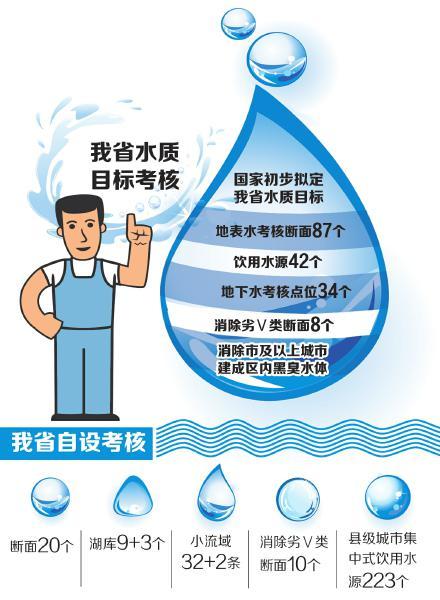
Reporters learned that the state has initially drafted water quality targets for Sichuan Province, including 87 surface water assessment sections, 42 drinking water sources, 34 groundwater assessment points, elimination of 8 sections with water quality below Grade V, and elimination of black and odorous water bodies in urban built-up areas of cities at the municipal level and above. Sichuan Province will establish 20 self-assessment sections, 9+3 lakes and reservoirs, 32+2 small watersheds, elimination of 10 sections with water quality below Grade V, and 223 centralized drinking water sources in county-level cities, etc. "For example, in Chengdu, the Huanglongxi monitoring section is currently classified as below Grade V, falling within the scope of pollution to be eliminated. Whether the target is met will be included in the annual assessment."
Sichuan's Optional Action Focuses on Total Phosphorus Pollution
Unusually, Sichuan specifically lists total phosphorus pollution control in its "Work Plan." The official stated that while Sichuan's overall water environment quality has remained stable in recent years, the water pollution situation remains severe. Total phosphorus is the primary indicator affecting the province's surface water quality standards. "Last year, the compliance rate of the main streams of Sichuan's five major river basins decreased by 17 percentage points year-on-year, and the overall compliance rate of the main streams and tributaries decreased by 5.7 percentage points." Therefore, the "Work Plan" prioritizes controlling and reducing total phosphorus pollution. In addition to the various conventional actions of "10," Sichuan has added an optional action of "1"—total phosphorus. In the "Special Rectification of '10+1' Key Industries," Sichuan has added the phosphorus chemical industry to the 10 industries including papermaking, coking, and nitrogen fertilizer. Meanwhile, key phosphorus-related industrial enterprises will install automatic online monitoring devices for total phosphorus; by the end of 2017, all existing urban sewage treatment facilities in the province will complete the task of adding automatic online monitoring devices for total phosphorus; the "implementation of a cross-border section water quality exceeding the standard deduction system" will include the deduction of total phosphorus pollutants; and total phosphorus pollution emissions will be controlled in nine cities—Chengdu, Meishan, Leshan, Yibin, Deyang, Ziyang, Neijiang, Zigong, and Luzhou—in the Minjiang and Tuojiang River basins where total phosphorus exceedances are concentrated.
The "Work Plan" proposes to implement a "red and yellow card" system. The pollution discharge situation of industrial enterprises will be investigated one by one, and all polluting units must achieve full compliance with emission standards in accordance with the law. The compliance status of polluting units will be regularly checked and made public. Enterprises exceeding standards and total quotas will receive a "yellow card" warning, and will be subject to production restrictions or shutdowns for rectification. Enterprises that fail to meet requirements after rectification and whose circumstances are serious will receive a "red card" penalty, and will be shut down. Starting in 2016, the list of enterprises receiving "yellow card" and "red card" warnings will be published quarterly on the website of the Environmental Protection Department.
Tiered water pricing for non-residential water use will be implemented by the end of 2020.
Regarding the system of paid use of resources, Sichuan is accelerating water price reform. "Cities should fully implement a tiered water pricing system for residents by the end of 2015; by the end of 2018, county towns and other established towns with the necessary conditions should, in principle, fully implement a tiered water pricing system for residents; by the end of 2020, a progressive pricing system for non-residential water use exceeding quotas and plans will be fully implemented. At the same time, comprehensive agricultural water price reform will be further promoted," the official said.
Reporters learned that a cross-border water environment ecological compensation mechanism will be established, and the "Sichuan Province Key River Basin Water Environment Ecological Compensation System Cross-Boundary Section Water Quality Assessment Ecological Compensation Fund Calculation Method" and supporting documents will be issued. "For the '9+3' key lakes and reservoirs with excellent water quality, as well as the Dadu River, Yalong River, and Qingyi River, ecological environment safety assessments will be conducted, and ecological environment protection plans will be formulated and implemented. The Zipingpu Reservoir will be completed by the end of 2017."
The "Work Plan" mentions that water use control will be implemented. By 2020, the total water consumption of the province will be guaranteed to be controlled within 32.1 billion cubic meters. In areas where the total water consumption is close to the control target, the approval of new water withdrawals for construction projects will be restricted; in areas where the total water consumption has reached or exceeded the control target, the approval of new water withdrawal permits for construction projects will be suspended.





