






Phone:
0086 28 87573647
+86 19150187139

Ion exchange, as the name suggests, involves the exchange of ions adsorbed on a resin with ions in the water. Ions in the water are adsorbed onto the resin, and the ions released from the resin into the water. There are many types of cations; in the hydrogen form, the resin adsorbs H ions, which exchange with positively valent cations such as calcium and magnesium in the water. The resin adsorbs calcium and magnesium ions, and the hydrogen ions are released into the water. Anions are similar, but the resin exchanges negatively valent anions.
In practice, mixed-bed exchange is generally used, meaning the entire exchange system contains both cations and anions to produce relatively pure water. If only one type of ion is used, the exchange is incomplete, and the treated water will be either alkaline or acidic. The ratio of cations to anions depends on the local water quality and the parameters required for water treatment.
If the local water hardness is high, more cations are needed.
If a slightly acidic water quality is desired, more cations are also needed, and the cations should be placed at the end of the treatment process.
Additionally, when using cations and anions, dechlorination is required at the front end; otherwise, the resin's lifespan will be significantly reduced.
Generally, this exchange system is used for water preparation, not placed in the aquarium. Whether or not this system is needed depends on the purpose of water preparation. If the local water is hard and unsuitable for fishkeeping, water preparation is necessary; otherwise, it is not. If you want to breed South American fish, especially native species, water preparation is essential.
There are two very different methods for preparing water, which have been used by aquarium experts for many years to obtain soft water:
One is the ion exchange method, which uses two connected containers as a site for cation and anion exchange, or a single container as a site for mixed ion exchange. This method has been used in Europe since 1975. However, over time, this method has been shown to cause many problems. On the one hand, the reprocessing process generates a large amount of hydrogen chloride and molten sodium bicarbonate solution, which requires special treatment. On the other hand, to completely remove minerals from the water, some untreated hard water needs to be added to adjust the water to contain the necessary dissolved solids. In recent years, abnormal substances found on the gill covers of juvenile discus fish have likely been traced back to the use of ion exchange.
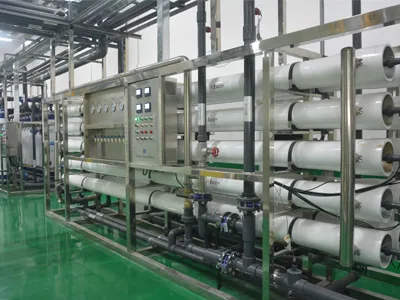
Secondly, there is reverse osmosis. Reverse osmosis systems have been used by aquarium experts worldwide for about 15 years. The soft water obtained through this technology contains less dissolved solids, depending on the membrane and the water mixture used. Similarly, some untreated hard water needs to be added to adjust the water to contain the necessary dissolved solids. However, unlike ion exchange, it does not require a reprocessing process.
Based on my experience and some theoretical knowledge, cation exchange resins primarily adsorb calcium and magnesium ions in the water, but also other ions. Moreover, in terms of adsorption capacity, calcium and magnesium ions are not the most adsorbed. Therefore, the resin not only adsorbs calcium and magnesium ions but also many other ions. Changes in water flow can wash away some of these ions, leading to uncontrolled water quality.
The formation of hydrogen chloride and sodium bicarbonate occurs because this resin is regenerated using salt. Calcium and magnesium ions are adsorbed by the cation exchange resin, while sodium ions from the cation exchange resin are released into the water. Nitrate and phosphate ions are adsorbed by the anion exchange resin, while chloride ions from the anion exchange resin are released into the water. This results in the formation of sodium chloride, along with small amounts of hydrochloric acid and sodium bicarbonate. However, the concentration of sodium chloride is actually not very high. In water with a hardness of 5 dH, after softening to 0 dH, the sodium salt concentration is only 0.01%, which has little impact on fish hatching. The concentrations of hydrochloric acid and sodium bicarbonate are even lower.
To verify the effects of hydrochloric acid and sodium bicarbonate on fish hatching, simply add 0.01% hydrochloric acid and sodium bicarbonate to normal water and observe whether it affects fish reproduction. Although I haven't conducted experiments on this, it seems plausible that it wouldn't have a significant impact. When I use resin to treat water, I never use the sodium form initially. Once I have the cation exchange membrane, I directly treat it with hydrochloric acid to the hydrogen form. This way, the water has no residual sodium. If I combine this with treatment of anions with sodium hydroxide, the treated water will be free of hydrochloric acid and sodium bicarbonate. However, treating cation exchange with hydrochloric acid is too expensive. I don't have the resources to test reverse osmosis yet. Theoretically, however, adding a certain amount of raw water to reverse osmosis water is equivalent to proportionally reducing the levels of each substance in the raw water. This method seems very effective.
In reality, water treated by ion exchange still contains a large number of impurities because the resin cannot adsorb all substances in the water. Using a high-quality membrane, however, reverse osmosis water is extremely pure.
After reverse osmosis, adding raw water ensures that the relative proportions of each substance in the water are the same as in the raw water, only the concentration is reduced. Water treated with resin, on the other hand, has completely different proportions of substances compared to the raw water.
Both methods are widely used. Both methods have successes and failures. Based on my analysis above, the quality of the effluent, whether using reverse osmosis or ion exchange, is closely related to the raw water. This is perhaps why both methods have examples of success and failure. The main problem likely lies with the raw water itself.
Commonly used cation exchange resins replace cations in water (mainly calcium and magnesium ions in hard water) with hydrogen ions (hydrogen-form cation exchange resin) or sodium ions (sodium-form cation exchange resin); anion exchange resins replace anions in water (mainly sulfate and nitrate ions) with hydroxide ions (hydroxyl-form anion exchange resin) or chloride ions (chloride-form anion exchange resin).
We routinely regenerate ion exchange resins using two methods: one is with table salt, and the other is with strong acids and bases (usually hydrochloric acid and sodium hydroxide). After regeneration with table salt, the cation exchange resin is in the sodium form, and the anion exchange resin is in the chloride form. After regeneration with strong acids and bases, the cation exchange resin is acidic, and the anion exchange resin is in the hydroxide form.
Let's look at the effects separately:
If you use a hydrogen-form cation exchange resin + a hydroxide-form anion exchange resin, the result is that hydrogen ions and hydroxide ions enter the water. What happens when these two combine? Water, H₂O! Harmless! Even if the amounts of hydrogen ions and hydroxide ions entering the water are different, the result is simply that there are more hydrogen ions or more hydroxide ions in the water. The former is equivalent to adding an acidifier to the water, lowering the pH; the latter is equivalent to a pH adjuster. Other than that, there are no other side effects.
If you use a sodium-form cation exchange resin + a chloride-form anion exchange resin, the result is that sodium ions and chloride ions enter the water. This is equivalent to sodium chloride ionizing in the water. Sodium chloride is table salt. Adding such a small amount of sodium chloride to the water is not only harmless but also beneficial.
As everyone knows, adding 400-500 ppm of table salt to water has a therapeutic and preventative effect on many fish diseases. Furthermore, the salt concentration in treated water is far lower than that. Even if a larger amount of sodium ions enters the water, it is simply equivalent to the ionization of sodium carbonate and sodium bicarbonate. These two substances in water are similar to adding baking soda, a common pH adjuster like sodium bicarbonate. There are no side effects; it simply raises the pH. If a large amount of chloride ions are introduced, they exist as ionized calcium chloride and magnesium chloride. These two salts are not harmful to fish (seawater contains large amounts of these two salts). Moreover, the concentration is very low, and their effect is negligible.
Let me end with a reassuring example. Many countries around the world, not just China, use ion exchange to treat water to produce purified water. Don't worry about a few discus fish; the requirements for purified water for humans are much higher than for fishkeeping. If there were any problems, there would have been a public outcry.
However, two points should be noted:
1. Ion-exchanged water can have a hardness close to 0. Although discus prefer soft water, too soft water is detrimental to breeding. Therefore, it is necessary to add hard water. Furthermore, after hatching, fry can absorb calcium and other substances more easily in slightly harder water, which is more beneficial for their growth.
2. The pH of the water after ion exchange will change, depending on the type and ratio of anion and cation exchange resins. Before use, the pH should be adjusted to the appropriate range with a pH adjuster.





