





![[19th Cpc National Congress] Xi Jinping: Accelerate the Reform of the Ecological Civilization System and Build a Beautiful China](/uploads/image/20260304/accelerate-the-reform-of-the-ecological-civilization-system-and-build-a-beautiful-china.webp "[19th Cpc National Congress] Xi Jinping: Accelerate the Reform of the Ecological Civilization System and Build a Beautiful China")
Phone:
0086 28 87573647
+86 19150187139

In ultrapure water treatment, a dedicated reverse osmosis process is employed to remove impurities such as inorganic salts, heavy metal ions, organic matter, colloids, bacteria, and viruses. This step is crucial, hence the widespread application of reverse osmosis technology in water treatment. However, a phenomenon known as back pressure exists in reverse osmosis systems. Back pressure refers to a situation where the pressure on the product water side is greater than the pressure on the feed water side. If this occurs, the desalination rate of the membrane element will be lost or significantly reduced. Therefore, from a safety perspective, reverse osmosis systems cannot have back pressure.
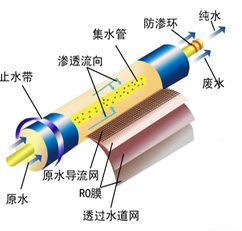
Because reverse osmosis membrane filtration is pressure-driven, back pressure is not present during normal operation. However, if a malfunction or operational error occurs, such as improper valve settings or opening/closing, back pressure may arise. Therefore, the issue of back pressure must be properly addressed.
Generally, reverse osmosis membrane technical manuals specify back pressure limit parameters. Therefore, the reverse osmosis design should strictly adhere to these limit parameters, and a check valve should be installed on the permeate pipe to prevent pressure buildup in the permeate pipe. The check valve should also be checked regularly for any leaks.
Another cause of back pressure is operational error. During reverse osmosis operation, if the pump is started without opening the permeate valve and permeate discharge valve, the system pressure will continuously rise, especially on the permeate side, but no water will be produced. If the operator stops the pump, the feed pressure will suddenly drop while the permeate pressure remains very high. Such high back pressure will immediately damage the membrane. Therefore, designers should also take this into account during the design process. A bypass can be added next to the production and discharge valve, and a rupture membrane can be installed on the bypass. Once the system is pressurized, it will automatically burst and release pressure to prevent greater losses.





