
Phone:
0086 28 87573647
+86 19150187139

Failure Control of Ion Exchange Demineralized Water Processors
The simplest process for ion exchange demineralized water treatment is a single-stage compound bed demineralization system consisting of a cation exchange bed and an anion exchange bed. Some single-stage compound bed demineralization systems use a unit system, meaning each system includes one cation exchange bed, one decarbonator, and one anion exchange bed. During operation, regardless of whether the cation exchange bed or the anion exchange bed fails first, they are regenerated simultaneously. Other single-stage compound bed demineralization systems use a master system, where cation exchange beds or anion exchange beds operate in parallel, and the exchanger that fails is regenerated.
1. Detection and Control Principles
The adsorption order of various cations in water by the strongly acidic cation exchanger is: Fe3+>Al3+>Ca2+>Mg2+>Na+>H+. Therefore, Na+ has the weakest adsorption capacity in water. During ion exchange, the various ion adsorption layers in the resin gradually shift downwards, and H+ is eventually replaced by other cations. When the protective layer is breached, the bottommost Na+ leaks first. Therefore, monitoring the failure of the cation exchanger is based on sodium leakage. The reaction equation is (A represents the metal cation, R is the resin group):
An+ + nRH = RnA + n H+
HCO3- + H+ = H2O + CO2↑
The adsorption order of various anions in water by the strongly basic anion exchanger is: SO42-->NO3-->Cl-->OH-->HCO3-->HSiO3-. Therefore, it can be seen that HSiO3- has the weakest adsorption capacity. During ion exchange, the various ion adsorption layers in the resin layer gradually shift downwards, and OH- is replaced by other anions. When the protective layer penetrates, the bottommost HSiO3- leaks first. Therefore, monitoring the failure of the anion exchanger is based on silicon leakage. The reaction equation is (B represents the acid radical anion, R is the resin group):
Bm- + mROH = RmB + mOH-
2. Control Points and Control Methods
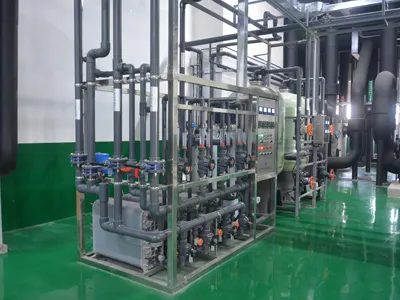
Since the main pipe system includes a unit system and has advantages such as full resin utilization, improved exchanger effluent capacity, and reduced acid and alkali consumption, our research mainly discusses the ion exchange demineralized water treatment system based on this structure. Taking the pure water station of the protein separation workshop of Chengdu Institute of Biological Products as an example, this system is a main pipe water treatment system. The system structure is as follows: sand filter - activated carbon filter - coarse filter - cation bed - primary anion - secondary anion - mixed bed - fine filter - pure water tank. The system has a water production capacity of 5 t/h. In the failure control research of the system, we proposed the concept of unit failure control, which is to make full use of the advantages of the main pipe water treatment system to control the failure of the system.