






Phone:
0086 28 87573647
+86 19150187139

As is well known, impurities in ultrapure water can have a series of adverse effects on devices. Therefore, determining the ultrapure water system process to ensure that production equipment meets the ultrapure water quality requirements becomes the primary issue to be addressed.
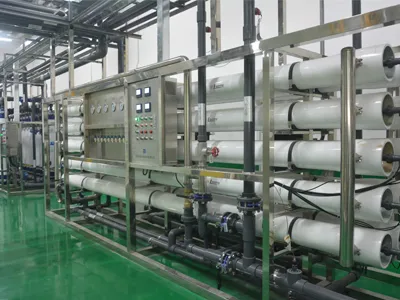
The ultrapure water preparation system for an integrated circuit factory should be determined based on the raw water quality and the ultrapure water quality requirements of the process equipment. It generally consists of the following four parts: a pretreatment system, a primary pure water treatment system, an ultrapure water production system, and a recycled water system.
The purpose of pretreatment is to remove suspended solids, colloids, high molecular weight organic matter, and other impurities from the water. It should be noted that activated carbon is very effective at removing total organic carbon (TOC), but it often becomes a breeding ground for microorganisms. Therefore, when using an activated carbon treatment unit in the pretreatment system, the influent to the activated carbon treatment unit should be acidic to prevent microbial growth.
In primary pure water treatment systems for ultrapure water production, reverse osmosis (RO) units are often used, with RO membranes primarily being cross-linked aromatic polyamide composite membranes. A drawback of these membranes is their poor oxidation resistance; oxidizing substances can cause polymer decomposition. Activated carbon, on the other hand, is highly effective at removing residual chlorine and peroxide from water. Therefore, employing an activated carbon treatment unit in the pretreatment system for ultrapure water production in ultra-large-scale integrated circuits is essential. The purpose of the primary pure water treatment system is to further treat the effluent from the pretreatment system. Representative devices include reverse osmosis, mixed ion exchange, primary membrane degassing, EDI (electro-regenerated desalination), UV (ultraviolet light), and primary polishing. Reverse osmosis and UV further remove TOC (total oxygen) remaining from the primary pure water treatment system; mixed ion exchange removes both TOC and SiO2; membrane degassing treats dissolved oxygen in the pretreated water; and primary polishing uses high-purity resin to treat metal ions.
Ultrapure water production systems are designed to remove trace impurities remaining in primary pure water treatment systems. It is noteworthy that while removing various impurities from the water, ensuring the removal of contamination caused by the materials of the equipment itself is a crucial concern. In other words, a complete ultrapure water system requires not only a rational water production process but also research into the trace leaching issues of each treatment device. Furthermore, the methods of ultrapure water delivery, and the selection of piping and valve materials, should also be given high priority.
Ultra-large-scale integrated circuit cleaning equipment almost exclusively requires ultrapure water. The wastewater from these cleaning equipment's water usage points can be almost entirely recycled. Part of the recycled water can be used as makeup water for cooling towers and exhaust gas scrubbing towers, while another part can be combined with the effluent from the ultrapure water pretreatment system and enter the pretreatment water tank as supplementary water for ultrapure water production. Currently, in practical engineering, the water recovery rate can reach 70%. To ensure the effectiveness of the recycled water system, in addition to determining a reasonable treatment process, it is also crucial to classify and collect wastewater from production equipment. This will prevent high concentrations of TOC and other impurities from entering the recycled water system.





