

Phone:
0086 28 87573647
+86 19150187139

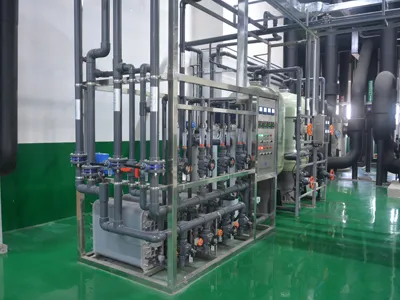
EDI (Electro-de-ionization, continuous electro-de-ionization), also known as EDI or continuous electro-desalination, is a process that utilizes mixed ion exchange resins to adsorb cations and anions from feed water. Simultaneously, these adsorbed ions are removed by passing through cation and anion exchange membranes separately under the influence of a direct current voltage. During this process, the ion exchange resin is continuously regenerated electrically, eliminating the need for acid and alkali regeneration. This new technology can replace traditional ion exchange devices, producing ultrapure water with a resistivity as high as 18 MΩ·cm.
An EDI device consists of ion exchange resin sandwiched between anion and cation exchange membranes to form EDI units. A certain number of EDI units are separated by a mesh to form concentrate chambers. Anodes and cathodes are placed at both ends of the unit group. Driven by a direct current, cations and anions in the water flowing through the desalination chamber pass through the cation and anion exchange membranes separately into the concentrate chamber and are removed from the desalination water. The water passing through the concentrate chamber carries the ions out of the system, becoming concentrate.
EDI equipment typically uses reverse osmosis (RO) pure water as its feed water. The resistivity of RO pure water is generally 40-2 μS/cm (25℃). EDI pure water resistivity can reach up to 18.2 MΩ·cm (25℃), but depending on the intended use of deionized water, EDI pure water is suitable for preparing pure water with a resistivity requirement of 1-18.2 MΩ·cm (25℃).
EDI technology is widely accepted in the pharmaceutical, microelectronics, power generation, and laboratory industries. Its applications in surface cleaning, surface coating, electrolysis, and chemical industries are also becoming increasingly widespread.
EDI can replace traditional mixed ion exchange technology (MB-DI) in producing stable deionized water. Compared with MB-DI technology, EDI technology has the following advantages:
① Stable water quality
② Easy to achieve fully automatic control
③ No downtime due to regeneration
④ No need for chemical regeneration
⑤ Low operating costs
⑥ Smaller plant area
⑦ No wastewater discharge