


Phone:
0086 28 87573647
+86 19150187139

Ion exchange filters raw water using spherical resins (ion exchange resins). Ions in the water exchange with ions fixed on the resin. Two common ion exchange methods are water softening and deionization. Water softening is primarily used as a pretreatment process to reduce water hardness before reverse osmosis (RO) treatment. The spherical resins in a softener soften the water by exchanging two sodium ions for one calcium or magnesium ion.
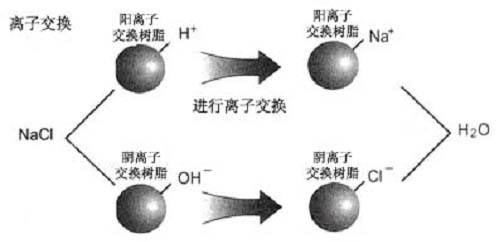
Ion exchange resins exchange hydrogen ions for cations and hydroxide ions for anions. Cation exchange resins made with styrene and divinylbenzene containing sulfonate groups exchange hydrogen ions for various cations they encounter (e.g., Na⁺, Ca²⁺, Al³⁺). Similarly, anion exchange resins made with styrene containing quaternary ammonium salts exchange hydroxide ions for various anions they encounter (e.g., Cl⁻). Hydrogen ions released from the cation exchange resin combine with hydroxide ions released from the anion exchange resin to produce pure water.
Cation and anion exchange resins can be packaged separately in different ion exchange beds, forming what are known as anion exchange beds and cation exchange beds. Alternatively, cation and anion exchange resins can be mixed together in the same ion exchange bed. Regardless of the method, once the resin has exchanged hydrogen and/or hydroxide ions with charged impurities in the water, it must be "regenerated." The regeneration process is the reverse of the purification process, using hydrogen and hydroxide ions to displace impurities attached to the ion exchange resin.
When ion exchange is combined with other water purification methods (such as reverse osmosis, filtration, and activated carbon adsorption), it plays a crucial role in the overall purification system. While ion exchange effectively removes ions, it is ineffective at removing most organic matter or microorganisms. Microorganisms can attach to the resin and use it as a culture medium, allowing for rapid growth and pyrogen generation. Therefore, it must be designed and used in conjunction with other purification methods.
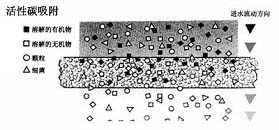
Organic matter can be cationic, anionic, or nonionic. Ion exchange resins can remove some soluble organic acids and bases (anionic and cationic) from raw water, but some nonionic organic matter can foul the resin. This process is called resin "fouling and clogging," which not only reduces the resin’s lifespan but also decreases its exchange capacity. To protect the ion exchange resin, an activated carbon filter can be installed before it to remove nonionic organic matter.
The adsorption process of activated carbon utilizes the pore size of the activated carbon filter and the permeability of organic matter passing through the pores. The adsorption rate is related to the molecular weight and size of the organic matter. Some granular activated carbon is more effective at removing chloramines. Activated carbon can also remove free chlorine from water, protecting other purification units in the pure water system that are sensitive to oxidants.
Activated carbon is often used in combination with other treatment methods. The appropriate configuration of activated carbon with other related purification units is a crucial aspect when designing a pure water system.
Microfiltration
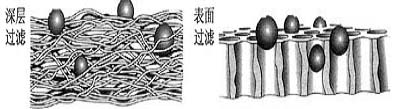
Microfiltration includes three types: depth filtration, screen filtration, and surface filtration. Depth filtration membranes use a matrix made of woven fibers or compressed materials to retain particles through random adsorption or trapping. Screen membranes have a uniform structure, like a sieve, retaining particles larger than the pore size on the surface (the pore size of these membranes is very precise). Surface filtration has a multi-layered structure; when the solution passes through the membrane, particles larger than the internal pores are retained and mainly accumulate on the surface.
Because these three types of membranes have different functions, distinguishing between them is crucial. Depth filtration is a more economical method, removing over 98% of suspended solids while protecting downstream purification units from fouling or clogging; therefore, it is often used as a pre-filtration process. Surface filtration removes over 99.99% of suspended solids and can also be used for pre-filtration or clarification. Microporous membranes (screen filters) are typically placed at the final point of use in purification systems to remove any remaining trace amounts of resin debris, carbon deposits, colloidal particles, and microorganisms. For example, 0.22 μm microporous membranes can filter out all bacteria and are commonly used for sterilizing intravenous fluids, serum, and antibiotics.
While microporous membranes remove particles based on pore size, ultrafiltration (UF) membranes act as molecular sieves to separate molecules in solution based on size. Ultrafiltration membranes are strong, thin, and selectively permeable membranes that retain most molecules larger than a certain size, including colloids, microorganisms, and pyrogens. Smaller molecules, such as water and ions, can pass through the membrane. Therefore, ultrafiltration concentrates large molecules in the retained solution; however, some large molecules will still leak into the filtrate.
Ultrafiltration membranes come in several different ranges; in all cases, ultrafiltration membranes retain most molecules larger than the molecular weight defined by their molecular sieve structure.
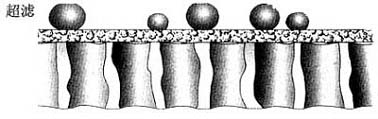
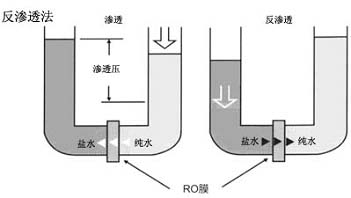
Reverse osmosis (RO) is the most economical method to achieve impurity removal rates of 90%–99%. The pore structure of RO membranes is denser than that of UF membranes, allowing RO membranes to remove all particles, bacteria, and organic matter with a molecular weight greater than 300 (including pyrogens).
When two solutions of different concentrations are separated by a semi-permeable membrane, osmosis occurs naturally. Osmotic pressure forces water through the semi-permeable membrane, diluting the more concentrated solution until concentration equilibrium is reached. In water purification systems, pressure is applied to the more concentrated solution to counteract osmotic pressure. This forces pure water from the more concentrated liquid through the RO membrane, which can then be collected. Due to the extremely high density of the RO membrane, the water flow is slow, requiring a considerable amount of time for sufficient water to accumulate in the storage tank.
RO membranes reject ions based on their charge, allowing only water to pass through while retaining all other ions and dissolved molecules (including salts and sugars). The higher the ionic charge, the greater the rejection. Therefore, RO membranes can remove almost all (>99%) strongly charged, high-valence ions. However, rejection of monovalent ions (such as sodium) is typically around 95%. Different feed waters require different types of RO membranes. RO membranes include cellulose acetate membranes and thin-film composite (TFC) polyamide membranes.
If the raw water and product water qualities are used as a benchmark, and with proper design, RO is the most economical and effective method for purifying tap water. RO is also the best pretreatment method for reagent-grade pure water systems.
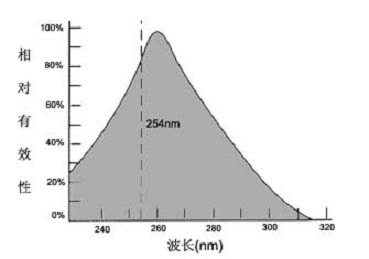
Ultraviolet irradiation is widely used in water treatment. The 254 nm ultraviolet light emitted by low-pressure mercury lamps is an effective sterilization method because the DNA and proteins in bacteria absorb ultraviolet light, leading to their death.
Recent advancements in UV lamp manufacturing technology have made it possible to produce ultraviolet lamps that simultaneously generate wavelengths of 185 nm and 254 nm. This combination of wavelengths can utilize photo-oxidation of organic compounds. Furthermore, these special bulbs can reduce the total organic carbon concentration in pure water to below 5 ppb.