








Phone:
0086 28 87573647
+86 19150187139

Consumables for laboratory pure water systems are an important component. This article provides detailed answers to questions about the working principle, composition, replacement time, and common problems of these consumables.
1. How does the reverse osmosis membrane in a laboratory pure water system remove impurities?
The pore size of the reverse osmosis membrane is around 10nm. Almost all inorganic ions are smaller than 10nm. The reverse osmosis membrane uses a charge aggregation effect to form ion clusters much larger than 10nm, thus removing inorganic ions. High-molecular-weight organic matter, colloids, and bacteria with diameters typically greater than 100nm (5000 Daltons) can be directly intercepted.
2. Why is the water produced by the reverse osmosis membrane in a laboratory pure water system initially dirty, how dirty is it, and how long does it take to stabilize at the normal desalination rate?
Reverse osmosis membrane desalination mainly relies on the charge effect. Initially, ions in the water move randomly. Small ions can freely move between the pure water and concentrated water sides of the membrane according to the principle of osmosis. When the reverse osmosis pressure exceeds the osmotic pressure, a large number of positive and negative charges cluster together and cannot pass through the reverse osmosis membrane. If the raw water TDS is 120 ppm, the membrane produces 100 ppm of water in the first second, 80 ppm in the second second, 62 ppm in the third second, 45 ppm in the fourth second, 30 ppm in the fifth second, and after 30 seconds it may be 5 ppm. After another 30 seconds, it stabilizes at 2 ppm, reaching the highest desalination rate.
3. Under which condition does a reverse osmosis membrane have a longer lifespan: continuous operation or intermittent operation?
The longer the reverse osmosis membrane operates continuously, the more stable the product water quality and the greater the total product water output.
4. How to determine if the problem is membrane clogging or insufficient pump thrust?
By blocking the wastewater with your finger, if the pure water flow does not increase, the membrane is clogged; if it increases significantly, the pump thrust is insufficient.
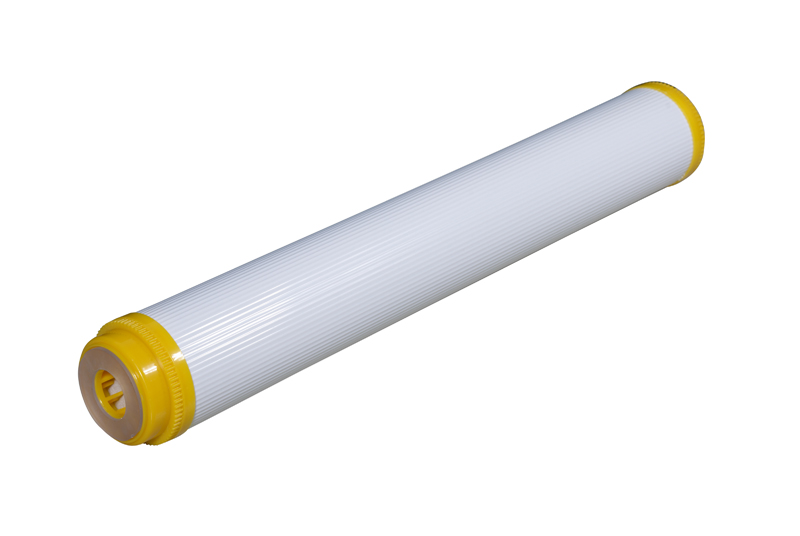
5. Why do laboratory pure water systems require regular replacement of consumables?
Pretreatment filter cartridges reach saturation when intercepting impurities, and the trapped contaminants become a breeding ground for microorganisms. This leads to biofouling, colloidal fouling, and even particulate matter clogging of the semi-permeable membrane in the subsequent reverse osmosis system. Under the action of the high-pressure pump, some membranes may rupture, allowing wastewater to directly enter the pure water system, causing widespread contamination of all water-passing components. The membrane pores themselves also accumulate contaminants due to trapped impurities, fostering bacterial growth. Therefore, regular replacement of the reverse osmosis membrane is essential. While ion exchange resins can achieve an UP (upper ion concentration) of 18.25M, they can still harbor microorganisms, leading to excessive levels of non-ionic substances such as organic matter, bacteria, pyrogens, ammonia nitrogen, absorbance, and particulate matter, affecting the ultrapure water blank value. Therefore, regular replacement of consumables is necessary to ensure trace-level ultrapure water.





