

Phone:
0086 28 87573647
+86 19150187139

Abstract: This article, written by a production supervisor at a power plant, provides firsthand experience. Through a case study of a power plant's technological upgrade project, it compares and analyzes the operation of EDI and mixed-bed boilers. It also compares domestically produced EDI with other similar domestic and international products, analyzing the technical performance of domestically produced EDI and its feasibility for promotion in the power industry.
Keywords: EDI, Power Plant Chemistry, Water Treatment
Based on the current status and existing problems of our power plant's chemical engineering, our plant adopted the EDI water treatment process developed by Hengshui Xinyu Company to replace the mixed-bed boiler, achieving ideal results. The analysis and summary are as follows:
Current Status of Water Supply Treatment at Jizhou Power Plant
The main equipment of Jizhou Thermal Power Plant consists of three 130T circulating fluidized bed boilers, equipped with two 25MW steam turbine generator sets. The main equipment pressure rating is high-temperature and high-pressure, with a main steam pressure of 9.8MPa and a temperature of 540℃.
The chemical water treatment process designed according to the unit requirements is as follows: Deep well water – Raw water tank – Raw water pump – Multi-media filter – Security filter – First-stage reverse osmosis – Decarbonization unit – Intermediate water tank – Intermediate water pump – Mixed bed.
The raw water quality analysis is shown in the table below:
Project | content | project | content |
Na+ k+ | 62 mg/L | Cl+ | 120mg/L |
Total Hardness | 96 mg/L | SO42ˉ | 130 mg/L |
electrical conductivity | 1020μS/cm | Total alkalinity | 109 mg/L |
Fe2+ | 0.12 mg/L | Total Silicon | 3.2 mg/L |
pH | 6.7 | No3ˉ | 16.4 mg/L |
Requirements for high-pressure boiler feedwater: Conductivity < 0.2 μS/cm, SiO2 < 20 ppb, hardness ≈ 0.
Problems with the original water treatment process:
The initial process design involved reverse osmosis effluent entering a first-stage desalination process before entering the mixed bed. This significantly increased equipment investment. Since direct entry of reverse osmosis effluent into the mixed bed could meet water quality requirements, this process was adopted. However, the water treatment cycle of the mixed bed was greatly shortened. Based on actual operation, the cycle output was 5000-8000 tons. The resin in the mixed bed undergoes a gradual deterioration process, resulting in a gradually changing conductivity curve. Within the water treatment cycle, the water quality gradually deteriorates from acceptable to unacceptable. There are instances of premature or delayed assessment, leading to fluctuations in water quality within a certain range. Furthermore, the use of acid-alkali regeneration increases equipment investment and operating costs, and inevitably increases the discharge of acid and alkali solutions, polluting the environment.
Comparison of Using EDI Instead of Mixed Bed
Based on the problems encountered during operation, we replaced the mixed bed with EDI, solving the two issues mentioned above.
EDI is a continuously operating device, eliminating operational cycle issues. The system's effluent resistivity reaches 14-15 MΩ/cm (equivalent to 0.06-0.07 μS/cm), and the water quality is stable. EDI uses simultaneous electroregeneration and water treatment, eliminating the need for acid/alkali regeneration, thus reducing related costs and pollutant emissions.
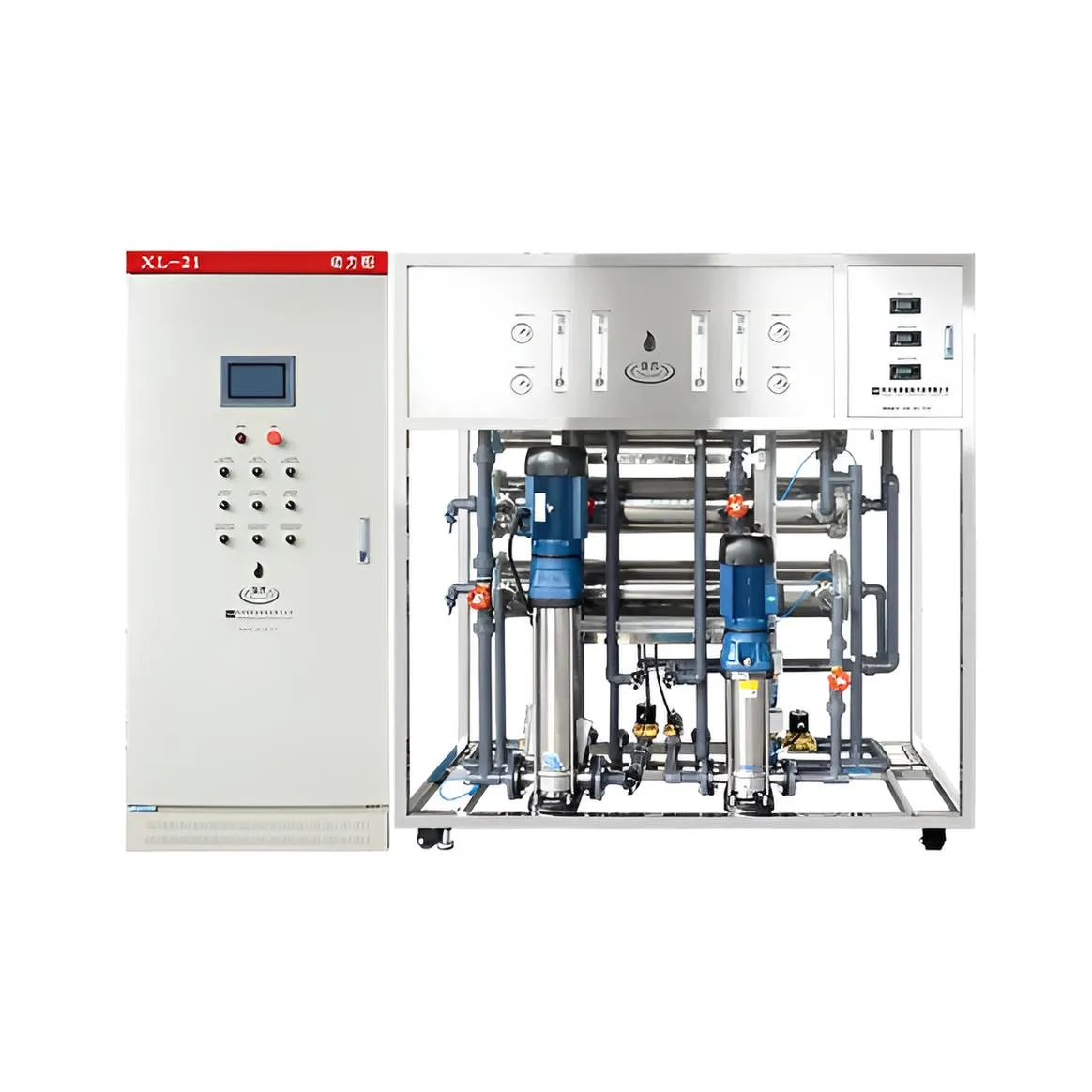
Our plant's reverse osmosis effluent conductivity is 13-15 μS/cm. According to conventional design, a two-stage reverse osmosis + EDI system should be used. We selected the EDI system from Hengshui Xinyu Water Treatment Technology Development Co., Ltd., breaking with conventional design by using a single-stage reverse osmosis + EDI system. After nearly six months of continuous operation, the results are excellent, reducing costs and saving funds. Moreover, after normal operation, no chemical addition is required; only the system's concentrate portion is circulated to maintain the conductivity of the concentrate chamber, achieving system balance.
Comparison of Effluent Water Quality
Comparison items | Mixed bed | EDI | Remark |
Chloride | 2 | 0 | mg/L |
Silicon dioxide | 3 | 2 | micrograms per liter |
Electrical conductivity | <0.2 | 0.06-0.07 | μS/cm |
Resistivity | 5 | 14-15 | MΩ/cm |
Comparison of operating costs
Comparison items | Mixed bed | EDI | Remark |
Acid | 0.25 kg/T | none | If the electricity cost is calculated based on the power plant's operating cost, the EDI operating cost per ton of water is 0.07 yuan/ton. |
Alkali | 0.3 kg/T | none | |
Power consumption | 0.18 kWh/T | 0.6 kWh/T | |
Comprehensive costs | 0.59 yuan/ton | 0.3 yuan/ton |
Taking a 50T/H system as an example, assuming 6000 hours of operation per year:
The direct operating cost of the mixed bed system is 177,000 yuan.
The direct operating cost of the EDI system is 90,000 yuan. The annual direct cost reduction is 87,000 yuan (based on the power plant's electricity cost of 21,000 yuan, the annual direct cost reduction is 156,000 yuan).
The equipment investment for a 50T/H mixed bed system (including acid and alkali storage and transportation, discharge equipment, metering equipment, multiplier equipment, etc.) is approximately 800,000 yuan, while the investment for an EDI system with the same water production capacity is 1 million yuan. However, the mixed bed system occupies 860 square meters, while the EDI system occupies only 20 square meters. Furthermore, the height requirement for the plant for EDI is significantly lower than that of the mixed bed system (only 3 meters). Therefore, although the initial investment for EDI equipment is slightly higher, considering all the above factors, the investment for EDI is actually less than that for the mixed bed system.
Conclusion:
Our plant's EDI technology upgrade project improved the water quality, meeting and even exceeding the water quality requirements of the high-pressure boiler and turbine. This technology upgrade reduced operating costs and extended equipment lifespan. It also eliminated the emission of acid and alkali pollutants, protecting the environment. It was a successful technological transformation project.
Based on our practical operating experience, using EDI instead of mixed-bed refrigerant has the following advantages:
1) Stable water quality: The resin in a mixed-bed refrigerant undergoes a gradual deterioration process, resulting in a gradually changing conductivity curve. During the water production cycle, the water quality gradually changes from acceptable to ineffective, leading to premature or delayed judgment. In contrast, the EDI water treatment process involves simultaneous exchange and regeneration, resulting in highly stable water quality.
2) Continuous operation, no regeneration required: Synchronous ion exchange and regeneration enable continuous production, eliminating the need for downtime regeneration and eliminating the need for acid and alkali storage and transportation equipment, as well as metering equipment.
3) Saves acid and alkali, reducing operating costs: EDI only consumes electricity, while mixed-bed refrigerant requires acid and alkali, thus resulting in lower operating costs.
4) No acid or alkali discharge, making it environmentally friendly, water-saving, and energy-efficient. All concentrated water is reused, with the wastewater discharge rate controlled below 5%, far less than the 10% wastewater discharge of ion exchange.
5) Simple installation and maintenance; no backup equipment required; repair or replacement of any membrane module will not affect the operation of other modules.
6) Simpler operation than mixed-bed systems; only the voltage and current of the rectifier power supply need to be adjusted, making fully automatic control easily achievable.
7) High-quality water; EDI pure water resistivity can reach up to 15 MΩ·cm, ensuring safe operation of high-parameter units and effectively extending the service life of boilers and turbines.
8) Smaller footprint and lower plant height requirements. Mixed-bed systems require a plant height of over 10 meters, while EDI plants only need a height of 3 meters, occupying approximately 3% of the space of a mixed-bed system, with a total investment of only 2/3 of that of a mixed-bed system.
9) Lower Total Investment: Although the price of EDI equipment itself is relatively high, when land and plant investment are included, the total investment for EDI is actually lower than that for mixed-bed systems.
Therefore, adopting EDI instead of mixed-bed systems to achieve a completely green, environmentally friendly, and energy-saving water treatment process is an inevitable direction for the development of power plants and power plant chemistry.
Author Biography: Liu Hongsheng is currently the Assistant Director of Jizhou Thermal Power Plant, Hebei Province. He graduated from the Department of Chemical Engineering, Hebei University of Technology in 1999. After starting his career, he served as a water treatment shift worker, chemical workshop director, head of the production technology department, and assistant director of the plant. He has a certain understanding and research experience in power plant chemistry and has worked in the production management of chemical processes such as ion exchange, reverse osmosis, and EDI. In 2005, he participated in the implementation of EDI localization.
The application of EDI in power plants described in this article has the following innovative aspects:
1. To our knowledge, the EDI equipment at Jizhou Thermal Power Plant is the only truly domestically produced EDI equipment used in large-scale production in China.
2. This project utilizes a highly successful single-stage reverse osmosis system as the feed water for EDI (Electronic Diode Refrigerant) projects. Most EDI projects, both domestically and internationally, use two-stage reverse osmosis as the feed water. Even the few domestic projects that reportedly used single-stage reverse osmosis as the feed water have been converted to two-stage systems due to operational failures.
3. For the reasons mentioned above, the cost of EDI projects will be significantly reduced, making the widespread adoption of all-membrane water treatment technology more economically advantageous and its application in the power industry more mature.