






Phone:
0086 28 87573647
+86 19150187139

Currently, membrane bioreactors can be divided into three categories: membrane separation bioreactors, membrane aeration bioreactors, and extractive membrane bioreactors. Membrane separation bioreactors are used for solid-liquid separation in wastewater treatment; in membrane aeration bioreactors, the membrane is used for gas mass transfer, typically supplying oxygen to aerobic processes, enabling bubble-free aeration and significantly improving oxygen transfer efficiency; extractive membrane bioreactors are mainly used for treating priority pollutants in industrial wastewater, with selectively permeable membranes used to extract specific pollutants. Currently, only membrane separation bioreactors have undergone extensive research and are in large-scale practical application; the following refers to membrane separation bioreactors.
There are many ways to classify membrane separation bioreactors. Based on the placement of the membrane modules, they can be divided into split-type and integrated membrane bioreactors; based on whether the bioreactor requires oxygen, they can be divided into aerobic and anaerobic membrane bioreactors.
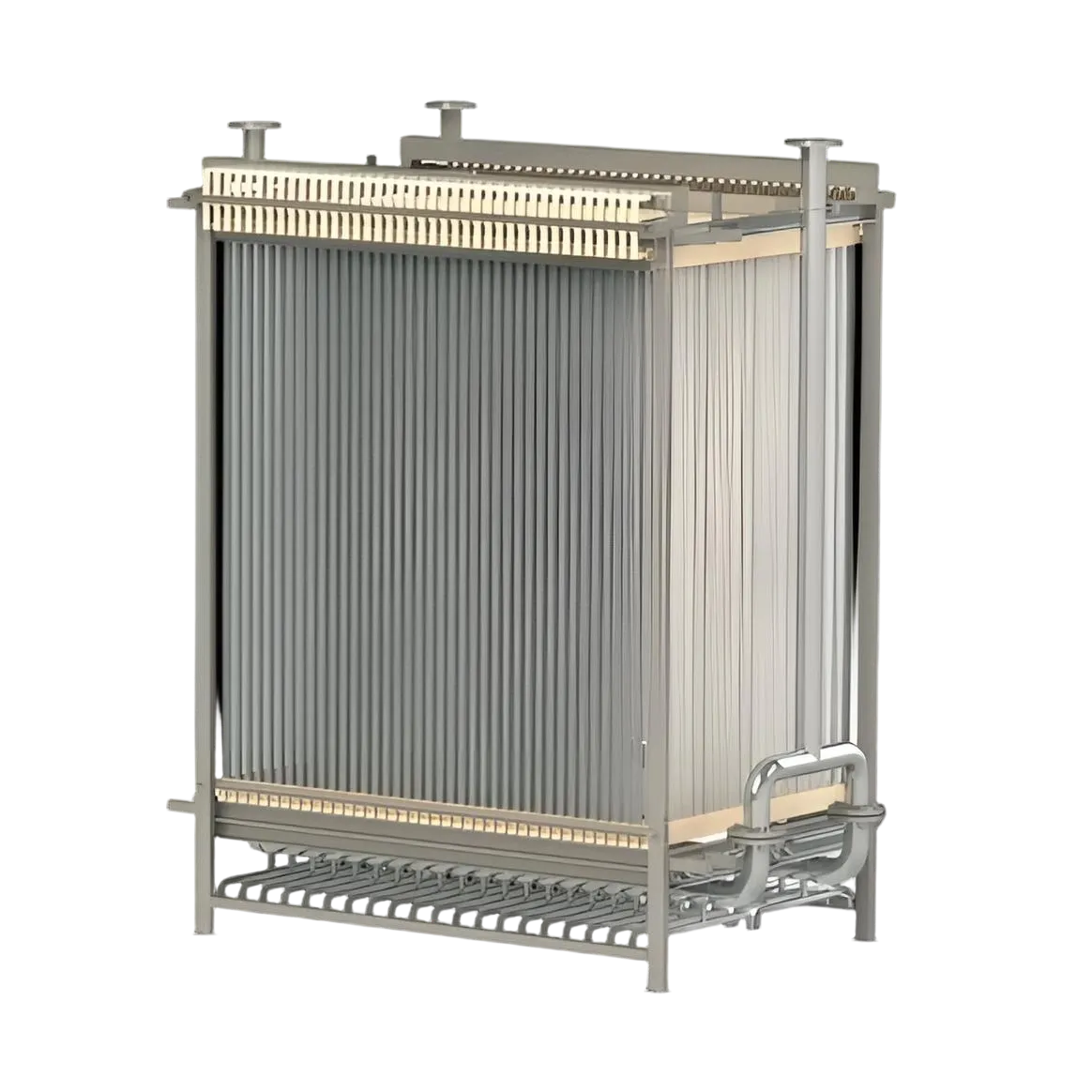
A split-type bioreactor separates the bioreactor and membrane module. The mixed liquor in the bioreactor is pressurized by a pump and enters the membrane module. Under pressure, the liquid in the mixed liquor permeates through the membrane to obtain the system effluent, while the activated sludge is retained and returned to the bioreactor with the concentrate. An integrated system places the membrane module directly inside the reactor. The filtrate is obtained by pumping, and the cross-flow required for membrane surface cleaning is generated by air agitation. An aerator is located directly below the membrane, and the mixed liquor flows upward with the airflow, generating shear force on the membrane surface to reduce membrane fouling. Aerobic membrane bioreactors are generally used for the treatment of municipal and industrial wastewater. Aerobic MBRs are typically used for municipal wastewater treatment to achieve effluent reuse, while their use in industrial wastewater treatment is mainly to remove specific pollutants, such as oily contaminants.
Combining membrane separation technology with anaerobic bioreactors has resulted in a new type of anaerobic biological treatment technology—the anaerobic membrane bioreactor—that is more efficient, lower energy consumption, and easier to control and start up. Traditional anaerobic biological treatment technologies aim to maintain high sludge concentrations, short hydraulic retention times (HRTs), and long sludge retention times (SRTs) to reduce investment and operating costs. In anaerobic membrane bioreactors (MBRs), the efficient retention of anaerobic sludge not only solves the problem of anaerobic sludge easily leaking from the bioreactor and causing effluent quality degradation, but also enhances the structure and treatment efficiency of the anaerobic reactor through membrane separation. Taking the combination of UASB and membrane units as an example, the anaerobic membrane reactor no longer requires a designed three-phase separator for solid-liquid-gas separation. For two-phase anaerobic MBRs, the membrane separation increases the concentration of acid-producing bacteria in the acid-producing reaction gas, improving hydrolysis and fermentation capacity. Simultaneously, the membrane retains large organic molecules in the acid-producing reactor for hydrolysis and fermentation, thus maintaining a high acidification rate. Anaerobic membrane bioreactors are used for treating high-concentration organic wastewater. Due to the lack of aeration in the bioreactor, and to keep the anaerobic sludge in suspension, anaerobic membrane bioreactors for treating high-concentration organic wastewater are typically designed as separate units.





