
Phone:
0086 28 87573647
+86 19150187139

Water Treatment
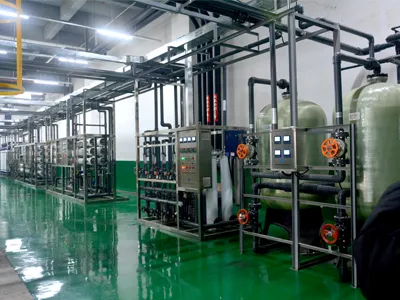
The demand for ion exchange resins in the water treatment field is substantial, accounting for approximately 90% of ion exchange resin production. They are used to remove various anions and cations from water. Currently, the largest consumption of ion exchange resins is in the pure water treatment of thermal power plants, followed by the nuclear energy, semiconductor, and electronics industries.
Food Industry
Ion exchange resins can be used in industrial plants for sugar refining, monosodium glutamate (MSG), wine refining, and bioproduct production. For example, high-fructose corn syrup is produced by extracting starch from corn, followed by hydrolysis to produce glucose and fructose, which are then ion-exchanged to generate high-fructose corn syrup. The consumption of ion exchange resins in the food industry is second only to water treatment.
Pharmaceutical Industry
Ion exchange resins play a crucial role in the development of next-generation antibiotics and the quality improvement of existing antibiotics. The successful development of streptomycin is a prime example.
Synthetic Chemistry and Petrochemical Industry
In organic synthesis, acids and bases are commonly used as catalysts for reactions such as esterification, hydrolysis, transesterification, and hydration. Ion exchange resins can replace inorganic acids and bases to perform the same reactions, with even more advantages. For example, the resin can be reused repeatedly, the products are easy to separate, the reactor is not corroded, there is no environmental pollution, and the reaction is easy to control.
The preparation of methyl tert-butyl ether (MTBE) uses a macroporous ion exchange resin as a catalyst, reacting isobutylene with methanol, replacing the previously used tetraethyl lead, which caused serious environmental pollution.
Environmental Protection
Ion exchange resins have been applied to many high-priority environmental protection issues. Currently, many aqueous or non-aqueous solutions contain toxic ions or non-ionic substances, which can be recycled using resins. Examples include removing metal ions from electroplating wastewater and recovering useful substances from film production wastewater.
Hydrometallurgy and Others
Ion exchange resins can be used to separate, concentrate, and purify uranium from depleted uranium ore, and to extract rare earth elements and precious metals.