


Phone:
0086 28 87573647
+86 19150187139

Scale inhibition and dispersion are the main and fundamental functions of water quality stabilizers. Establishing correct, simple, and objective methods for evaluating the performance of scale inhibitors is one of the tasks of water treatment professionals. Currently, commonly used evaluation methods in Chinese laboratories include the static scale inhibition method, the bubbling method, and the limiting carbonate hardness method. These methods mostly suffer from drawbacks such as long testing times, cumbersome operation, and poor reproducibility. Therefore, based on a comprehensive evaluation and improvement of these methods, we have successively proposed evaluation methods such as the pH shift method and the conductivity method. Compared with classical methods, the pH shift method and the conductivity method have advantages such as shorter experimental cycles (reduced from 6-24 hours to 2-10 minutes), simpler operation (requiring only one pH meter or conductivity meter), and better data reproducibility. However, they still only reflect the contribution of chelation, and the measurement results cannot reflect the comprehensive performance of the scale inhibitor. Although the calorimetric method can simultaneously reflect the contributions of crystal nucleation and growth processes, it is affected by the accuracy of temperature measurement (using a Beckman thermometer with a temperature measurement accuracy of 0.001℃), resulting in a large systematic error and making it difficult to reflect the subtle differences between different scale inhibitors. Therefore, exploring an objective, fair, and simple method for evaluating the comprehensive scale inhibition performance of scale inhibitors in the laboratory is a work of practical significance.
From the perspective of the mechanism of action, the action of scale inhibitors can be divided into three parts: chelation, dispersion, and lattice distortion. In laboratory evaluation tests, dispersion is a remedy for chelation, and lattice distortion is a remedy for dispersion.
1.1 Chelation
The process by which a complex with a cyclic structure is formed by the bonding of a central ion with two or more coordinating atoms of the same polydentate ligand under certain conditions is called chelation. The result of chelation is that scale-forming cations (such as Ca²⁺, Mg²⁺, etc.) react with the chelating agent to form stable chelates, thereby preventing their contact with scale-forming anions (such as CO₃²⁻, 5O₄²⁻, Po₄⁻, and 5I₀₃²⁻, etc.), greatly reducing the probability of scale formation. Chelation is stoichiometric; for example, one EDTA molecule chelates one divalent metal ion. The chelating capacity of chelating agents can be expressed by their calcium chelation value. The typical chelating capacities of commercial water treatment agents (all active components in the following agents have a mass fraction of 50%, and chelating capacity is expressed as CaCO3): Aminotrimethylene succinic acid (ATMP) – 300 mg/g; Diethylenetriaminepentamethylene succinic acid (DTPMP) – 450 mg/g; Ethylenediaminetetraacetic acid (EDTA) – 150 mg/g; Hydroxyethylenediamine disuccinic acid (HEDP) – 450 mg/g. This translates to 1 mg of chelating agent chelating less than 0.5 mg of CaCO3 scale. To stabilize calcium and magnesium ions with a total hardness of 5 mm0FL in a circulating water system, 1000 mL of chelating agent would be required, a dosage that is economically unfeasible. Therefore, the contribution of scale inhibitors to chelation is only a small part. However, in low to medium hardness water, the chelation effect of scale inhibitors still plays a crucial role.
1.2 Dispersion Effect
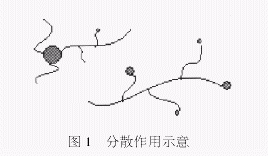
The dispersion effect is illustrated in Figure 1. The result of dispersibility is to prevent scale-forming particles from contacting and agglomerating, thereby inhibiting scale growth. Scale-forming particles can be calcium and magnesium ions, or scale particles composed of hundreds or thousands of CaCO3 and MgCO3 molecules, as well as dust, silt, or other water-insoluble substances. Dispersants are polymers with a certain relative molecular mass (or degree of polymerization), and their dispersing performance is closely related to their relative molecular mass (or degree of polymerization). If the polymerization is too low, the number of adsorbed and dispersed particles is small, resulting in low dispersion efficiency; if the polymerization is too high, the number of adsorbed and dispersed particles is excessive, causing the water to become turbid and even forming flocs (in which case the effect is similar to that of flocculants). Compared with chelation, dispersibility is highly efficient. Experiments show that 1 mg of dispersant can stably contain 10-100 mg of scale-forming particles in circulating water. In medium-to-high hardness water, the dispersing function of scale inhibitors plays a major role.
1.3 Effect of Lattice Distortion
When the system has high hardness and alkalinity, and the added chelating and dispersing agents are insufficient to completely prevent their precipitation, precipitation is inevitable. Without a dispersant, scale growth will follow the general laws of crystal growth, and the resulting scale will firmly adhere to the heat exchanger surface. With sufficient dispersant, the scale-forming particles (composed of hundreds or thousands of CaCO3 molecules) are adsorbed and surrounded by the dispersant, preventing them from aligning on their regular lattice points. This makes the resulting scale soft and easily carried away by the water flow. X-ray diffraction patterns and scanning electron microscope images of scale samples formed with and without dispersant are shown in Figures 2 and 3.
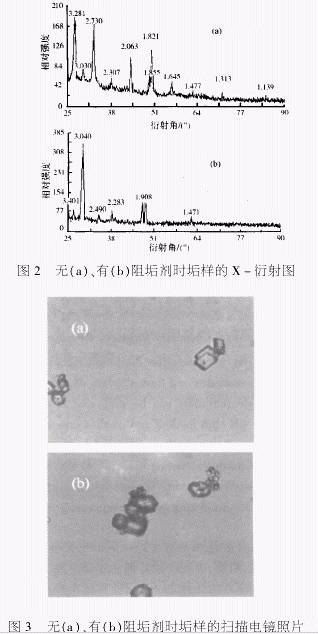
As shown in Figures 2 and 3, the CaCO3 scale sample without dispersant has a regular shape, a hard texture, and its X-ray diffraction pattern also has definite peaks. After adding dispersant, the CaCO3 scale sample is amorphous, soft, and its X-ray diffraction pattern shows weaker crystalline characteristics, indicating that the presence of dispersant does indeed change the crystal structure and has a good lattice distortion effect. In high-hardness, heavily scaled water, the lattice distortion performance of scale inhibitors plays a major role.
2.1 Determination of Chelating and Partial Dispersing Capacity
In the scale inhibitor evaluation test, the sample after reaching equilibrium is allowed to stand for 10 hours or cooled to room temperature. The concentration of stable calcium ions in the supernatant or filtrate is titrated with EDTA. The scale inhibition performance of the scale inhibitor is evaluated based on the concentration of stable calcium ions in the supernatant or filtrate. Methods of this type include static scale inhibition, bubbling, and limiting carbonate hardness methods.
In the presence of scale inhibitors, Ca2+ in the solution exists in the following forms: free calcium ions (very small proportion), calcium ion pairs (such as [CaOH]+, [CaSO4]+, [CaCl]+, [CaCl2]O, [CaHCO3]+, etc., relatively small proportion), calcium chelates (the proportion depends on the concentration of the chelating agent), CaCO3 particles adsorbed by the dispersant and suspended in the solution, and CaCO3 sludge adsorbed by the dispersant and deposited at the bottom of the container. As the hardness or concentration factor increases, the number and size of calcium carbonate particles in the solution increase, thus the proportion of CaCO3 adsorbed by the dispersant and not suspended in the solution increases.
Clearly, the so-called supernatant or filtrate contains only free calcium ions, calcium ion pairs, calcium chelates, and some CaCO3 particles adsorbed by the dispersant and suspended in the solution. Under conditions of low hardness and high scale inhibitor concentration, this may contain most of the total calcium in the solution, and using the measurement results under these conditions to represent the scale inhibitor's scale inhibition ability is correct. However, when the solution hardness is high and the scale inhibitor concentration is relatively low, the CaCO3 sludge-like scale deposited at the bottom constitutes most of the total calcium in the solution. In this case, using the calcium ion content in the supernatant or filtrate to represent the scale inhibitor's scale inhibition ability is incorrect.
2.2 Determination of Chelating Ability
The pH shift method and conductivity method are methods for measuring the changes in pH and conductivity of a solution caused by the combination of Ca2+ and CO32- [6-8]. Since the growth (or aggregation) and aging of CaCO3 crystals do not cause changes in the H+ concentration and the number of conductive particles in the solution, the pH shift method and conductivity method are methods for simply measuring the chelating ability of scale inhibitors.
Studies have shown that within a certain hardness range, the results obtained by the pH displacement method and conductivity method exhibit the same trend as those of the classic static scale inhibition method and bubbling method, indicating that the essence of the measurement content of these two types of methods is the same or similar. It can be further inferred that in measurement methods such as the static scale inhibition method, bubbling method, and limiting carbonate hardness method, the contribution of dispersing ability is relatively small compared to chelating ability; that is, the scale inhibition contribution of dispersing ability is rarely considered.
2.3 Scale Inhibition Performance of Conventional Scale Inhibitors under Traditional Evaluation Methods
Since conventional scale inhibitor performance evaluation methods (static scale inhibition method, bubbling method, limiting carbonate hardness method, pH displacement method, and conductivity method) mainly measure the chelating performance of the agent, they rarely consider the dispersing ability of the agent, and do not include the lattice distortion ability of the agent. Therefore, these methods are applicable to evaluating the scale inhibition performance of scale inhibitors in medium and low hardness water, but they are not applicable to high hardness water, and the results obtained are incorrect. Because HEDP and ATMP have good chelating abilities, the above evaluation methods lead to the conclusion that their scale inhibition ability is superior to any scale inhibitor/dispersant (such as polyacrylic acid (PAA), hydrolyzed polymaleic acid (HPMA), polyepoxybenzoic acid (PESA), phthaloyl carboxylic acid copolymer (POCA), and polyamino polyether methylene succinate (PAPEMP), etc.). This is clearly incorrect. Furthermore, these methods are almost indistinguishable between various scale inhibitors/dispersants (including water-based and solvent-based polymaleic acid), which is also unreasonable.
A composite agent suitable for water with high hardness, high alkalinity, and high concentration ratios has been evaluated using classical methods, yielding a scale inhibition rate of 20%-35%. Dynamic simulation methods yield a scale inhibition rate >90%. In a circulating water system with a total hardness of 7.5 mmol/L, alkalinity of 9.2 mmol/L, and a concentration ratio of 2.5, no scaling occurred after three years. This further demonstrates that currently widely used methods for evaluating scale inhibition performance (static scale inhibition method, bubbling method, limiting carbonate hardness method, pH shift method, and conductivity method) are one-sided and far removed from reality in evaluating the performance of scale inhibitors in high-hardness water.
Many methods can be used to evaluate the performance of scale inhibitors. For example, scanning electron microscopy can be used to observe the nucleation, growth, aggregation, and adsorption processes of crystals. Atomic force microscopy can be used to study the growth of calcium carbonate crystals in the presence of scale inhibitors, revealing the inhibitory effect on growth. X-ray diffraction can be used to compare the fineness of scale samples, the degree of crystal distortion, and changes in crystal system under different scale inhibitor conditions. Particle size analyzers can be used to study the nucleation and growth kinetics of scale-forming substances under different scale inhibitor conditions. However, most of these methods require specialized instruments and are only adopted by research institutions, making them difficult to promote among users and in field evaluations.
Dynamic simulation is the most reliable method for evaluating the performance of corrosion and scale inhibitors, but it is not a fast, efficient, or cost-effective method due to its long experimental time and high consumption of resources. The hard scale determination method used in our laboratory can simultaneously measure the chelation contribution, dispersion contribution, and lattice distortion contribution of the scale inhibitor. Its basic steps are: conduct a scale inhibition test using the bubbling method; after bubbling, rinse the scale sample on the vessel wall with the undiluted solution at a flow rate of 1 m/s for 2 minutes, discard the sample, and the residue on the vessel wall is considered hard scale. Wash the vessel wall with excess hydrochloric acid, dilute the washing solution to a certain mark, and then analyze the Ca2+ concentration in the washing solution. A higher Ca2+ concentration indicates a greater amount of hard scale, and a worse overall scale inhibition performance of the scale inhibitor. The results obtained by this method are consistent with the results of field practice. Establishing standardized operating procedures can improve the reproducibility of the evaluation results, making it a practically valuable method for evaluating scale inhibition performance.