

Phone:
0086 28 87573647
+86 19150187139
Continuous Electro-deionization (EDI, CDI) is a process that utilizes mild ion exchange resins to adsorb cations and anions in the feed water. Simultaneously, these adsorbed ions are removed by passing through separate cation and anion membranes under a direct current voltage. This process eliminates the need for acid and alkali regeneration of the ion exchange resin. This new technology can replace traditional ion exchange (DI) devices to produce ultrapure water with a resistivity as high as 18 MΩ•cm. EDI ultrapure water equipment is used after reverse osmosis systems, replacing traditional mixed-bed ion exchange technology to produce stable ultrapure water. Compared with mixed-bed ion exchange technology, EDI technology has the following advantages:
Stable water quality;
Easy to achieve fully automatic control;
No downtime due to regeneration;
No need for chemical regeneration;
Low operating costs;
Small plant area;
No wastewater discharge.
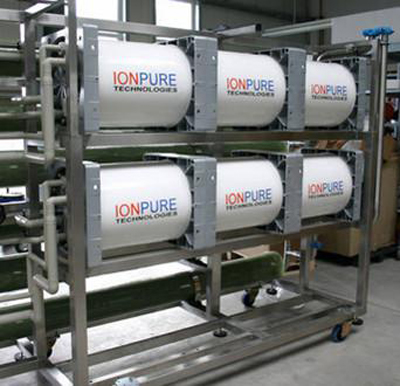
Natural water bodies generally contain dissolved substances such as sodium, calcium, magnesium, chlorides, salts, and hydrocarbons. These compounds consist of negatively charged anions and positively charged cations. Through reverse osmosis (RO), more than 95%-99% of these ions can be removed. The resistivity of RO pure water (EDI feed water) generally ranges from 0.05-1.0 MΩ•cm, which translates to a conductivity range of 20-1 μS/cm. Depending on the specific conditions, the resistivity of deionized water generally ranges from 5-18 MΩ•cm. Additionally, raw water may also contain other trace elements, dissolved gases (such as CO2), and some weak electrolytes (such as boron and silica). These impurities must be removed in industrial demineralized water. However, reverse osmosis is less effective at removing these impurities. Therefore, the role of EDI is to increase the resistivity of water from 0.05-1.0 MΩ•cm to 5-18 MΩ•cm by removing electrolytes (including weak electrolytes).
Ion exchange membranes and ion exchange resins operate on similar principles, selectively allowing ions to pass through. Anion exchange membranes allow only anions to pass through, while cation exchange membranes allow only cations to pass through, blocking anions. A mixed ion exchange resin is filled between a pair of anion and cation exchange membranes to form an EDI unit. The space occupied by the mixed ion exchange resin between the anion and cation exchange membranes is called the desalination chamber. Arranging EDI units together, alternating between anion and cation exchange membranes, and adding a special ion exchange resin between the membranes creates a space called the concentrate chamber. Under a given DC voltage, in the desalination chamber, the anions and cations in the ion exchange resin migrate towards the positive and negative electrodes, respectively, and pass through the anion and cation exchange membranes into the concentrate chamber. Simultaneously, ions in the feed water are adsorbed by the ion exchange resin, occupying the vacancies left by ion electromigration. In fact, ion migration and adsorption occur simultaneously. Through this process, ions in the feed water pass through the ion exchange membranes into the concentrate chamber and are removed, becoming demineralized water.
Pretreatment of the feed water is a primary prerequisite for achieving EDI performance and reducing equipment failures. Contaminants in the feed water can negatively impact the desalination unit, increasing maintenance and reducing the lifespan of the membrane module.