






Phone:
0086 28 87573647
+86 19150187139

Every type of mechanical equipment needs maintenance, and pure water equipment is no exception. A good pure water system cannot function without strict operation and management. So how do we maintain and service our large and medium-sized pure water systems?
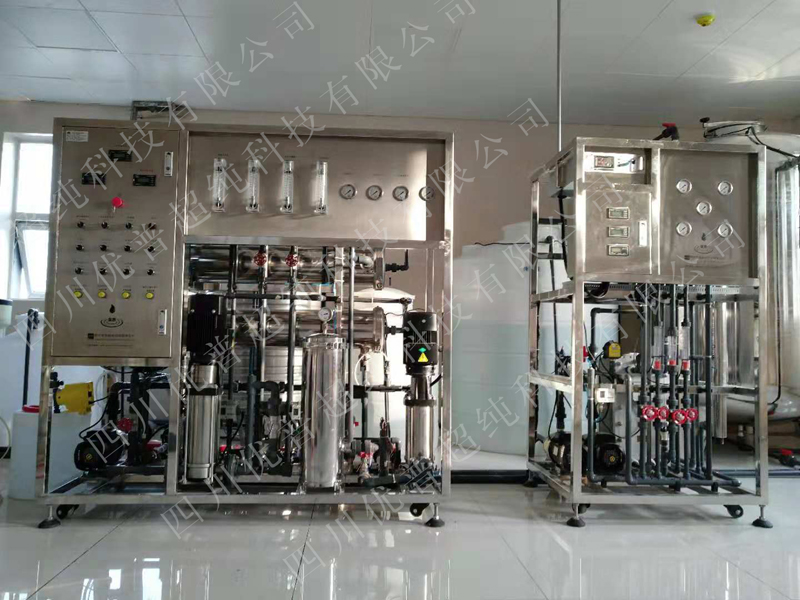
1. Before starting the machine and after stopping it, the quartz sand filter and activated carbon filter should be backwashed until the sewage is completely drained. A 30-minute continuous backwash should be performed once a week to ensure that the turbidity of the influent is controlled.
2. Filter Cartridge Replacement
For single-core or multi-core stainless steel precision filters, filter cartridge replacement depends mainly on the pressure difference. Generally, replacement should be considered when the pressure difference is greater than 0.03 MPa. The method is as follows:
(1) Multi-core stainless steel precision filter
① Close the inlet and outlet valves; ② Open the vent valve until the pressure gauge indicates zero; ③ Loosen the locking nut and open the top cover; ④ Remove the filter cartridge and replace it with a new one; ⑤ Install the filter top cover and tighten the locking nut; ⑥ Open the inlet valve and simultaneously open the top vent valve to allow air to escape from the filter. (2) Single-core dense filter:
① Close the inlet and outlet valves; ② Slowly unscrew the valve at the outlet of the filter to release pressure; ③ Then use a special plastic wrench to unscrew the filter shell counterclockwise; ④ Remove the filter element and replace it with a new one; ⑤ Install the filter shell and tighten it; ⑥ Open the inlet valve.
3. Cleaning the RO membrane: No matter how perfect the pretreatment is, various pollutants present in the water will accumulate on the membrane during long-term operation, causing a decrease in the performance of the device (desalination rate and water production) and an increase in the inlet and outlet pressure of the components. Therefore, the RO membrane needs to be chemically cleaned or replaced. Cleaning Conditions:
① When the RO membrane's permeate flow rate decreases by 10-15% compared to the initial commissioning or the last cleaning;
② When the RO membrane's desalination rate decreases by 2.5-5% compared to the initial commissioning or the last cleaning;
③ When the pressure difference between each section is 1-2 times that of the initial commissioning or the last cleaning.
If any of the above three conditions occur, chemical cleaning or replacement of the RO membrane is required.
4. System Precautions
(1) Newly installed reverse osmosis equipment or newly replaced membrane modules must be flushed at low pressure to remove the membrane preservative from the concentrate and permeate, preventing the preservative from flowing into the finished water tank. Permeate should be discharged until the permeate quality meets standards.
(2) The normal operating temperature of the reverse osmosis equipment is 5°C-35°C, with an optimal temperature of 24°C-27°C and a maximum temperature of 35°C. For every degree Celsius increase or decrease in the influent temperature, the permeate flow rate will increase or decrease by 2.7-3.0%. (3) Once the reverse osmosis unit is put into operation, it must run for at least 1 hour daily. During holidays, staff should be on duty.
(4) If oscillation occurs during startup, it is likely due to low inlet pressure of the high-pressure pump, possibly caused by excessive concentrate opening, excessive pressure differential of the multi-media filter, or low outlet pressure of the raw water pump. Adjustments are necessary in all cases.
(5) Regularly compare previous operating data (such as pressure, flow rate, desalination rate, permeate volume, and temperature). If significant differences are found, analyze the cause and address it promptly.
(6) The system should not be shut down for more than two days (especially during the hot summer months). Protective operation is required when water is not used for extended periods. Before a long-term shutdown, the RO membrane must be purged with a protective solution (such as a 0.1-1.0% formaldehyde solution).
(7) The softening filter in the pretreatment system must be regularly replenished with salt in the PE brine tank to ensure the solution remains saturated. Otherwise, RO membrane blockage will occur, and the user will bear all consequences. (8) Operators must accurately fill out the daily operation record form for reference by our after-sales personnel during maintenance.
(9) Operators should regularly inspect the security filter element. It is recommended to replace the security filter element once a week within the first month after initial installation.





