





Phone:
0086 28 87573647
+86 19150187139

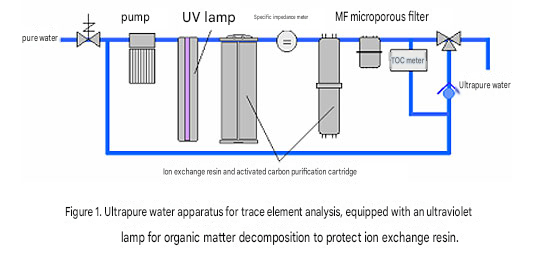
ICP and ICP-MS can effectively analyze almost all elements, and are therefore widely used in the semiconductor industry, nuclear industry, and environmental sample elemental analysis. ICP-MS, in particular, can analyze trace amounts of metals, so the ultrapure water used must be purified to the limit of metal removal.
In the purification methods of ultrapure water systems, ion exchange resins are used to remove ions, so maintaining the resin's exchange capacity is crucial. Besides the reduced removal capacity due to functional group saturation, organic matter and microorganisms can also adhere to the resin surface. Therefore, in the pretreatment process of the ion exchange resin, it is best to use a UV lamp to oxidize and decompose organic matter to prevent resin contamination. Furthermore, to detect resin degradation as early as possible, an impedance meter can be installed after the ion exchange cartridge to detect changes in water quality (Figure 1). This combination of ultrapure water systems can achieve a detection sensitivity of ppt for elements in water.
Factors affecting ICP-MS analysis include the cleanliness of the container and extraction issues. When performing analysis of trace amounts of inorganic ions, it is essential to use containers with high purity and that do not readily dissolve metal ions. Other technical issues, such as bubble generation in the nebulizer and the influence of Ar on the detection signals of K and Ca ions, can be addressed by removing dissolved gases from the water.





