


Phone:
0086 28 87573647
+86 19150187139
One water molecule (H₂O) is formed by the bent bonds of one oxygen atom and two hydrogen atoms. Because the centers of positive and negative charges are not aligned, it is a polar molecule. When two water molecules coexist, they are attracted to each other and maintain a certain distance through electrostatic interactions and hydrogen bonds. One water molecule can simultaneously bond with four other water molecules, forming a crystalline, orderly structure.
In water molecule aggregates, the network structure of hydrogen bonds partially breaks, resulting in a state of successive movement and change. Therefore, water as a whole exists as a liquid, and this structural change can occur up to 10¹² times per second.
Generally speaking, water tastes good if it contains appropriate amounts of sodium and potassium ions and silicates, while it tastes bad if it contains a large amount of residual salts, such as magnesium and calcium, which are not acidic or neutral salts. In other words, water contains many other components besides H₂O, and the types and amounts of these components determine the taste of the water.
Water readily dissolves salts. Even when cations and anions are strongly bound together by electrostatic interactions, electrolysis is easily achieved in water. This is because water molecules can combine with ions to form "hydrated ions." Ions have very small radii, and ions with large charges interact strongly with water molecules, causing the water molecules to align closely around the ions. At this point, cations interact with oxygen atoms carrying negative polarities, while anions form the opposite structure.
1. Soluble Inorganic Matter: Inorganic salts, dissolved gases, heavy metals, hardness components (calcium, magnesium, etc.).
2. Soluble Organic Matter: Lignin, tannins, humic acid, endotoxins, RNA-degrading enzymes, pesticides, chloroform, endocrine disruptors, surfactants, organic solvents.
3. Microparticles: Rust, colloids, suspended solids, particulate matter.
4. Microorganisms: Bacteria, algae.
National standards for laboratory water vary depending on the type of experiment. Grade I water is used for analytical experiments with stringent requirements, such as liquid chromatography. Grade II water is used for inorganic trace analysis, such as atomic absorption spectrometry. Grade III water is used for general chemical analysis experiments.
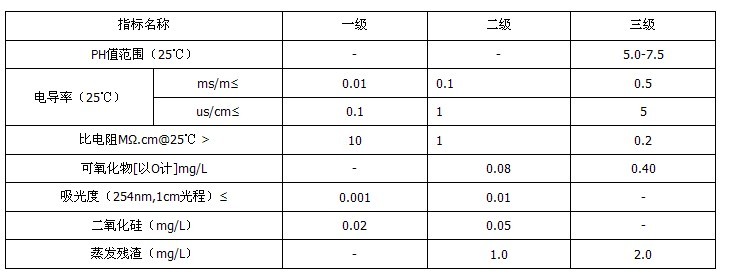
Supplementary Notes: Because it is difficult to determine the true pH value of Grade I and Grade II water at their purity levels, national standards do not specify pH ranges for these waters. Similarly, because it is difficult to determine oxidizable substances and evaporation residues at the purity levels of Grade I water, no limits are specified for their amounts; other conditions and preparation methods can be used to ensure the quality of Grade I water.