

Phone:
0086 28 87573647
+86 19150187139

On May 23, Zou Shoumin, Director of the Department of Science and Technology Standards of the Ministry of Environmental Protection, stated that a batch of urgently needed environmental quality standards and pollutant emission standards will be issued as soon as possible. Among them, environmental quality standards for agricultural land and construction land soil will be issued within the year.
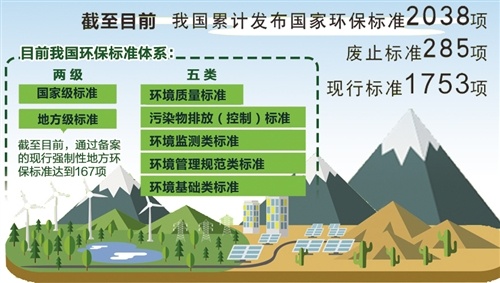
At a regular press conference held by the Ministry of Environmental Protection that day, Zou Shoumin reported that, to date, my country has issued a total of 2,038 national environmental protection standards, of which 1,753 are currently in effect, and 167 are currently filed as mandatory local environmental protection standards.
According to reports, my country currently has 16 national environmental quality standards, covering major environmental elements such as air, water, soil, noise and vibration, and nuclear and radiation; and 163 current national pollutant emission (control) standards, including 75 air pollutant emission standards with 120 controlled items; and 64 water pollutant emission standards with 158 controlled items.
"Overall, the number and stringency of pollutants controlled in my country's air and water pollutant emission standards are comparable to those of major developed countries and regions," said Zou Shoumin.
Data provided by the Department of Science and Technology Standards of the Ministry of Environmental Protection shows that since the 12th Five-Year Plan, in accordance with the requirements of the "Ten Measures for Air Pollution Prevention and Control," 35 air pollutant emission standards have been issued for key industries such as thermal power, coking, steel, cement, oil refining, and petrochemicals. Currently, industry-specific, general-purpose, and mobile source emission standards control more than 95% of the total national emissions of particulate matter, sulfur dioxide, and nitrogen oxides.
Furthermore, since the 12th Five-Year Plan, 26 industry-specific pollutant emission standards have been issued for industries such as textiles, synthetic ammonia, phosphate fertilizers, citric acid, steel, and chemicals. Currently, industry-specific water pollutant emission standards control more than 80% of the corresponding chemical oxygen demand (COD) and ammonia nitrogen emissions in my country's industrial wastewater, and more than 90% of the corresponding heavy metal emissions such as mercury, cadmium, lead, arsenic, and hexavalent chromium.
Zou Shoumin frankly stated that some current projects are relatively advanced, and bottlenecks such as insufficient scientific research and practical foundation to support the drafting, issuance, and implementation of standards have led to slow progress in some projects, failing to promptly support management needs. Furthermore, the coordination and support between quality standards and pollutant emission (control) standards and new systems such as discharge permits urgently need to be strengthened.
Zou Shoumin revealed that during the 13th Five-Year Plan period, 800 to 1000 environmental protection standards will be introduced to address the shortcomings of existing standards, and pollutant emission standards will be revised, especially tightening air pollution emission standards.
According to the "National Environmental Protection Standards 13th Five-Year Development Plan," a number of key standards will be introduced during the 13th Five-Year Plan period, including seawater quality standards, nearshore marine ecological environment quality evaluation specifications, and passenger car interior air quality evaluation guidelines. Standards for stationary source pollutants, including pesticides, electronics, coatings, paints, and dyes, will be released, as well as standards for mobile sources such as light and heavy vehicles (National VI emission standard), ship engines, and motorcycles and mopeds (National IV emission standard).
It is reported that the Ministry of Environmental Protection will strengthen the management of environmental protection standards during the 13th Five-Year Plan period, especially for standards urgently needed for management, adjusting the project initiation mechanism, accelerating the approval process, and establishing a "green channel" for standard formulation, revision, and release.