Phone:
0086 28 87573647
+86 19150187139

My country currently has a two-tiered, five-category environmental protection standard system, consisting of national and local standards. The categories include environmental quality standards, pollutant emission (control) standards, environmental monitoring standards, environmental management standards, and basic environmental standards.
By the end of the 12th Five-Year Plan period, a total of 1,941 national environmental protection standards had been issued (493 of which were issued during the 12th Five-Year Plan period), 244 standards were repealed, and 1,697 standards remained in effect. Among the current environmental protection standards, there are 16 environmental quality standards, 161 pollutant emission (control) standards, 1,001 environmental monitoring standards, 481 management standards, and 38 basic environmental standards.
The "13th Five-Year Plan for the Development of National Environmental Protection Standards" indicates that approximately 800 environmental protection standards will be issued in the future, including approximately 100 quality standards and pollutant emission (control) standards, approximately 400 environmental monitoring standards, and approximately 300 basic environmental standards and management standards, supporting key environmental management work.
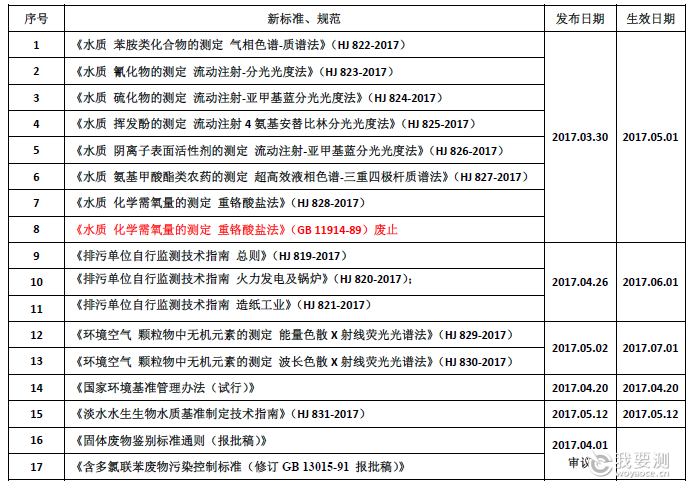
The following is a summary of the new standards and regulations released by the Ministry of Environmental Protection in the first half of 2017:
Environmental Monitoring Standards
Based on the environmental management needs outlined in the "Ten Measures for Air Pollution Control," "Ten Measures for Water Pollution Control," and "Ten Measures for Soil Pollution Control," and considering advancements in monitoring technology, the 13th Five-Year Plan period will focus on constructing an environmental monitoring standard system to support the implementation of quality and emission standards, and will implement the requirement of establishing a unified environmental quality monitoring network as outlined in the "Ecological Environment Monitoring Network Construction Plan" (State Council Document No. 56 [2015]).
During the 13th Five-Year Plan period, in water, air, and soil environmental monitoring, the focus will be on revising standards for environmental monitoring and analysis methods for heavy metals, pesticides, persistent organic pollutants, volatile organic compounds (VOCs), and odor pollutants; improving the technical specifications system for surface water and wastewater, air and exhaust gas, and soil environmental monitoring; and revising and developing technical specifications for monitoring ecological environment, biology, environmental vibration, and environmental noise. Monitoring and control of major pollutants, heavy metals, and VOCs will be strengthened, and technical requirements for automatic environmental monitoring systems will be revised and developed. Emphasis will be placed on developing standard samples urgently needed for environmental monitoring and scientific research, including VOCs, polychlorinated biphenyls (PCBs), polybrominated diphenyl ethers (PBDEs), pesticides, and heavy metals, and improving the environmental standard sample system.
VOCs Emission Control Standards
In recent years, VOCs have gradually come into the public eye as a new type of air pollutant. Since 2013, the state has successively issued a number of policies and measures, including the "Technical Policy for the Prevention and Control of Volatile Organic Compounds Pollution," the "Action Plan for Reducing Volatile Organic Compounds in Key Industries," and the "Pilot Measures for Charging VOCs Emissions." Furthermore, the 13th Five-Year Plan outlined VOCs as a new component of the total emission control targets for the first time, proposing to promote VOCs emission control in key regions and industries, with a national emission reduction of more than 10%.
By the end of 2016, 15 provinces and municipalities had implemented VOCs emission charging. Beijing, Shanghai, Anhui, Jiangsu, Hebei, Hunan, Sichuan, Liaoning, Tianjin, and Zhejiang have established clear VOCs emission charging standards.
On April 12, to promote the improvement of air quality in the Beijing-Tianjin-Hebei region, Beijing, Tianjin, and Hebei jointly formulated the "Standard for Limits of Volatile Organic Compound Content in Building Coatings and Adhesives," which will be implemented simultaneously from September 1. This is the first unified standard issued by the three regions in the environmental protection field.
The State Administration for Quality Supervision, Inspection and Quarantine and the Standardization Administration of China approved the national standard "Waterborne Wood Coatings for Children's Rooms" on December 30, 2016, which will be implemented on July 1st of this year. The children's paint standard strictly limits the levels of harmful substances such as VOCs, free formaldehyde, benzene, toluene, ethylbenzene, and total xylene.
Many provinces, including Beijing, Jiangsu, Hebei, Henan, and Shaanxi, have issued emission control standards for volatile organic compounds (VOCs). The "Shaanxi Province VOC Emission Control Standard" (DB61/T1061-2017) has been implemented since February 10, 2018. Jiangsu Province's "Chemical Industry VOC Emission Standard" (DB32/3151-2016) and "Surface Coating (Furniture Manufacturing) VOC Emission Standard" (DB32/3152-2016) have been implemented since February 1, 2017.