





Phone:
0086 28 87573647
+86 19150187139

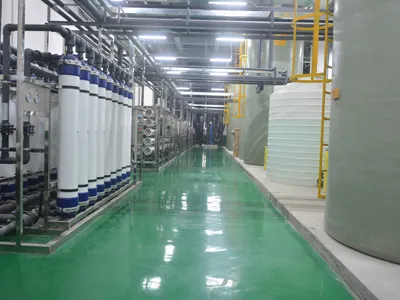
The raw water filtration system is a crucial component of the chemical water treatment process in thermal power plants. The quality of the raw water directly impacts the normal operation of subsequent water treatment equipment and the quality of demineralized water, thus affecting the long-term safe operation of power and thermal equipment. Our plant's original system was designed for a maximum output of 480 t/h. Due to the expansion project during the "15th Five-Year Plan" period, the increased supply of demineralized water, the corresponding increase in raw water volume, and the higher water quality requirements meant that the existing two gravity valveless filters with a processing capacity of 240 t/h could no longer meet production demands, and the system had inherent problems, making renovation inevitable. After investigation and thorough evaluation, it was decided to adopt a new type of bundled soft packing material—a pressure-type high-efficiency fiber filter using fiber materials as filter elements.
1. Current Status and Problem Analysis of the Production System
1.1 Original Process Flow
The raw water filtration equipment, specifically the valveless filter, uses granular quartz sand as filter elements and is designed using hydraulic principles as a constant velocity filter with a flow rate of 6–10 m/h. The raw water system process flow is shown in Figure 1. The raw water originates from the Yangtze River. After coarse filtration, it enters the low-temperature power plant heat exchanger (exchange 4) in the water supply system, where it exchanges heat with the oil refinery's recycled hot water (hot demineralized water) to reach approximately 40°C. It then passes through a valveless filter bed to a clear water tank (pool), from which it is pumped to subsequent water treatment equipment (demineralized water treatment system).
1.2 Problems with the Original System
(1) Due to the deterioration of the incoming water quality, both exchange 4 units are severely clogged and have accumulated sludge, affecting the heating of the raw water. One unit often needs to be shut down for maintenance, but the output of a single exchange 4 unit is low, and the raw water temperature does not meet the process requirements. This reduces the cycle water production of the ion exchangers and increases water production costs.
(2) The valveless filter bed consumes a large amount of its own water during backwashing and carries away a significant amount of heat, resulting in substantial heat waste. (3) Valveless filters occupy too much space. A valveless filter with a processing capacity of 240 t/h has dimensions of 8m × 4m × 3.6m. Due to site and production constraints, it is impossible to build a larger valveless filter. Furthermore, filtration using granular filter media results in filtration accuracy limited by the particle size, leading to effluent turbidity as high as 5 mg/L. Cleaning the filter media is also overly cumbersome, prone to buildup, and requires frequent replacement, resulting in high labor intensity.
2. Feasibility Analysis
To address the problems of the original system, after investigation and analysis, adhering to the principles of advanced technology and high automation, we adopted PLC control to modify the raw water system process flow. The process flow is shown in Figure 2. The incoming raw water first passes through four D3000mm high-efficiency fiber filters before entering the cryogenic power plant for heating, and then flows into the clear water tank. The designed output of a single high-efficiency fiber filter is 210 t/h. 2.1 Working Principle of High-Efficiency Fiber Filters
High-efficiency fiber filters are filtration devices that use bundles of expanded fiber filaments (D20-50μm) with weights attached to their lower ends, suspended from a perforated plate located at the top of the filter as the filter medium. Several capsules are placed within the fiber bundles near the perforated plate. During filtration, water is first filled into the capsules to forcefully compress the surrounding fiber bundles, making them compact. Then, water flows upwards through the fiber pores. The working state of the fiber filter is shown in Figure 3.
During cleaning, the water in the capsules is first drained, and the compression on the fiber bundles is removed. The fiber bundles are then allowed to return to their expanded state under the combined action of gravity and the elasticity of the expanded fibers. Then, air and water are introduced for combined agitation and scrubbing. Because the fiber used as the filter element is a flexible and bendable material, its filter media diameter can reach tens of micrometers, and there are a large number of gaps in the filter media layer. During the filtration process, different fiber porosities can be obtained by controlling the compression conditions of the fiber bundles. The filter efficiency and resistance can then be controlled within a set range. This solves the problem that traditional filtration equipment such as valveless filters, siphon filters, and mechanical filters, which use granular filter media such as quartz sand, have filtration accuracy limited by the large particle size of the filter media.
The small diameter of the filter media greatly increases the specific surface area and surface free energy of the filter media, increasing the contact opportunities between impurities in the water and the filter media, and enhancing the adsorption capacity of the filter media, thereby improving filtration efficiency and dirt-holding capacity.
3. Implementation
3.1 Process Flow
The process flow of the high-efficiency fiber filter in our plant is shown in Figure 4.
Before the filter starts operating, the chamber is filled with water to ensure that the pressure chamber reaches the set pressure. The filter must be pre-run during startup, and only after the turbidity of the effluent is tested and found to be within acceptable limits can it be integrated into the system. During filter operation, the flow rate must be adjusted smoothly to prevent sudden flow changes from causing filter products to be carried out, resulting in excessive turbidity in the effluent. The filter cleaning process consists of four steps: bladder drainage → fan start → bottom washing → top washing.
3.2 Operating Status
This filtration system has been in use in the water treatment system since July 29, 2000. To understand its operating patterns and ensure safe, efficient, and reasonable operation, we conducted an experiment on the filter's operating cycle.
The system uses PLC control, and three parameters are used for single filter failure control: (1) inlet and outlet pressure difference ≥ 70 kPa; (2) effluent turbidity ≥ 2 mg/L; (3) set cumulative water production per cycle. Meeting any one of these parameters confirms failure.
The system is designed with four operating modes: manual operation—manual control of each valve opening and closing; semi-automatic operation—manual control of each time; semi-automatic—the entire process is divided into three stages: bladder filling, operation, and cleaning; and fully automatic—from bladder filling to cleaning and reaching standby status. Since water turbidity analysis is performed manually, a semi-automatic operation mode is generally sufficient to meet the needs of safe production.
Due to the seasonal influence of the Yangtze River, the cycle water production varies with the season. A cycle water production of 8000-10000t can guarantee the quality of the effluent. The maximum turbidity of the incoming water is 60mg/L, and the minimum is only 5mg/L, but the effluent turbidity meets the requirements. The filter can intercept pollutants under any circumstances, protecting subsequent processes.
4. Economic and Social Benefits
After a year and a half of operation following the modification, the raw water system has solved the problems existing in the original process, improved the effluent quality and output, and reduced production costs.
(1) Water Consumption Calculation: The high-efficiency fiber filter has a large cycle water production and low backwash water consumption, reducing water consumption and sewage discharge. Water consumption comparison calculations are shown in Table 2. Annual water savings from the filter = (filter water production rate - valveless filter water production rate) × total annual raw water volume = (0.983 - 0.974) × 3,500,000 = 31,500 t
Annual sewage discharge fee savings = 4.5 × 31,500 ≈ 140,000 yuan
(2) Heat energy calculation: Due to the adoption of the new process, the backwash water used in the filtration equipment is not heated, reducing heat loss. =Annual backwash water volume of valveless filter = Annual water production volume × (1 - water production rate) = 3,500,000 × (1 - 0.974) = 91,000 t
Backwash water heat loss = Raw water temperature rise × Backwash water volume × 4.18 = 15 × 91,000 × 4.18 = 5.71 × 10⁶ MJ
Converted to standard oil = 5.71 × 10⁶ / 41.87 = 136.37 t Where: 41.87——calorific value of 1 kg standard oil, MJ/kg
(3) Process effect: The effluent quality of the high-efficiency fiber filter is improved, making the effluent turbidity stable and less than 2 mg/L, reducing the burden on the cation exchanger, effectively increasing the cycle water production of the ion exchanger, reducing acid and alkali consumption, and reducing the pollution of the resin.
(4) The problem of clogging of ion exchanger 4 is solved, the heat exchange effect of ion exchanger 4 is improved, and maintenance costs are saved. Before the upgrade, the two heat exchangers (unit 4) frequently clogged due to poor raw water quality, requiring 2-3 maintenance cycles per unit per year. Raw water bypassed the heat exchangers and flowed directly into the valveless filter, while the hot demineralized water was cooled by circulating water, increasing the load on the circulating water system. Simultaneously, the low raw water temperature reduced the cycle water production of the downstream ion exchanger and increased acid and alkali consumption. In the year and a half since the upgrade, no clogging has occurred, saving maintenance costs and reducing the workload of workers.
5. Conclusion
Compared to valveless filters using quartz sand as filter media, high-efficiency fiber filters with fiber as the filter media offer advantages such as high filtration efficiency, fast filtration speed, large dirt-holding capacity, large cycle water production, low self-consumption, and small footprint. They also solve problems inherent in the original process flow, resulting in significant economic and social benefits. Further improvements in filter media cleaning technology, simplification of the internal structure of the filtration equipment, enabling direct treatment of high-turbidity influent, and addressing the issue of large-scale fiber filtration equipment could lead to wider applications in the water treatment field.





