





Phone:
0086 28 87573647
+86 19150187139

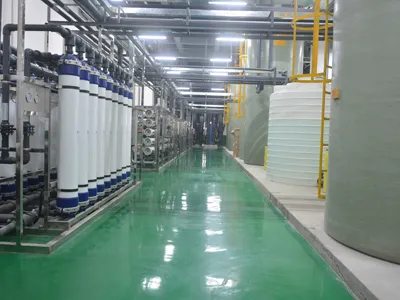
The past 30 years have been a period of rapid development of ultrafiltration technology. Ultrafiltration separation technology has been widely used in drinking water preparation, food industry, pharmaceutical industry, industrial wastewater treatment, metal processing coatings, biological product processing, petroleum processing and other fields. Large-scale water treatment typically focuses on: drinking water supply terminals, surface water treatment, seawater treatment and fluid reuse.
(1) Drinking water treatment
As the quality requirements for drinking water become increasingly stringent, water treatment companies invest increasing efforts in controlling the amount of microorganisms present in the water supply network. To do this, one approach is to conduct expensive, frequent water quality tests, or to install barriers at water terminals to prevent the entry of bacteria and viruses.
Using the UF system, such a barrier can be built very easily. The removal rate of ultrafiltration membranes for bacteria can reach 6log, and the removal rate for viruses can reach 4log. Therefore, water plants and water users do not have to worry about bacteria and viruses. Since the quality of drinking water itself is very high (turbidity and suspended solids are very low), the membrane system at this time can use a very high membrane flux, which can reach 135 liters/square meter per hour. At the same time, the water inlet conditions are relatively high, so the frequency of backflushing and chemically enhanced backwashing can be very low, and the water production can reach 99%. If necessary, a two-stage ultrafiltration system can be set up to further reuse the first-stage backwash water.
(2) Surface water treatment
UF systems are widely used in surface water treatment. The treated water is used for irrigation or as reverse osmosis water to prepare industrial water.
In the Netherlands, more and more such factories are popping up. This technology provides a new way of using industrial water, that is, it is not necessary to purchase increasingly expensive drinking water, but to use nearby surface water after treatment.
(3) Seawater desalination
The Middle East is where water scarcity is most severe. In order to solve this problem, people usually used distillation technology at the earliest. From the 1860s, membrane technology has been used to solve the water shortage problem in these countries. However, many reverse osmosis desalination systems face serious problems of membrane fouling. Mainly because the traditional pretreatment method of reverse osmosis system cannot provide reliable incoming water quality. Therefore, the vast majority of desalination plants operate at far lower than their designed water output, and the water output of some plants even does not reach 30% of the originally designed water output.
Research on small desalination devices has clearly shown that ultrafiltration systems can control seawater quality with great certainty and provide high-quality incoming water for reverse osmosis systems. Long-term tests also show that the SDI value of the effluent of the ultrafiltration system can be very well controlled below 2. These tests do not require any pretreatment before the ultrafiltration system and are applicable to a variety of seawater qualities.
(4) Sewage reuse
Western countries have put a lot of effort into treating wastewater, but after treatment they only discharge it into surface water sources through drainage pipe networks. This is very unreasonable. Once again, ultrafiltration offers an attractive solution for wastewater reuse due to its price advantage.
In fact, wastewater discharged from urban sewage treatment plants and factories is a very good water resource for industrial water and even drinking water. This is technically possible, but it is very difficult for Western users to believe this approach. This is not so much a technical problem as a psychological one. However, an 850-ton/hour water plant is currently under construction in Windhoek, Namibia, which uses membrane technology to reuse the effluent from the sewage treatment plant as drinking water.





