






Phone:
0086 28 87573647
+86 19150187139

Ultrapure water systems require regular maintenance, and one of the most important aspects is cleaning the RO reverse osmosis membrane. After a period of normal operation, the RO membrane elements can become contaminated by suspended solids or sparingly soluble substances that may be present in the feed water. Regular water flushing and chemical cleaning can restore the performance of the membrane elements and extend their lifespan.
I. When Does the Membrane Need Cleaning?
The frequency of membrane cleaning is closely related to the completeness of the pretreatment measures. The more complete the pretreatment, the longer the cleaning interval; conversely, the simpler the pretreatment, the higher the cleaning frequency. The need for membrane cleaning can be determined based on the following:
1. The permeate flow rate drops to 10%-15% of its normal value under normal pressure;
2. To maintain normal permeate flow rate, the feed water pressure, after temperature correction, increases by 10%-15%;
3. The permeate water quality decreases by 10%-15%;
4. The desalination rate decreases by 10%-15%;
5. The operating pressure increases by 10%-15%;
6. The pressure differential at each stage of the RO reverse osmosis system increases significantly, etc.
II. Contaminants in Reverse Osmosis Membrane Elements:
Common contaminants in RO reverse osmosis membrane elements include calcium carbonate, calcium sulfate, metal oxides, silicates, inorganic or organic precipitates, natural organic matter, synthetic compounds (cationic polyelectrolytes), and microorganisms (algae, molds, fungi), etc. III. Cleaning methods can be divided into physical cleaning and chemical cleaning.
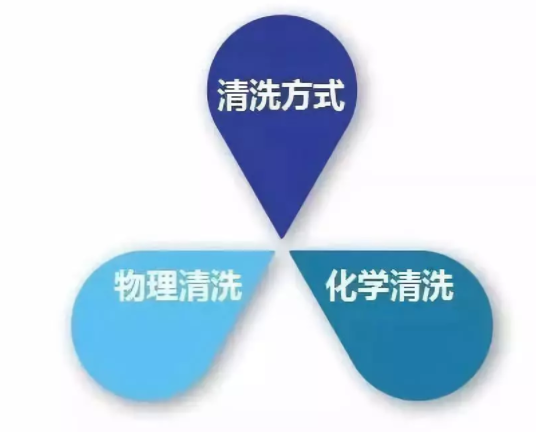
1. Physical Cleaning: Physical cleaning uses mechanical rinsing to remove contaminants from membrane elements and restore their performance. Various physical methods, such as turbulence, vibration, gas-water mixing, and ultrasound, can be used to wash away contaminants adsorbed on the membrane elements. (See diagram below.):
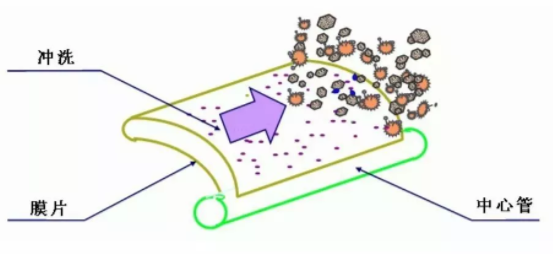
Diagram of membrane surface condition during cleaning
Advantages of physical cleaning: For reverse osmosis membrane fouling, especially for contaminants with low adsorption capacity, physical cleaning can effectively remove contaminants. Physical cleaning does not change the properties of the contaminants; it removes them through force.
Disadvantages of physical cleaning: ① Not suitable for prolonged or frequent use; ② Physical cleaning can easily lead to a decrease in permeate flow; ③ Improper operation is more likely to cause membrane damage than chemical cleaning; ④ Cannot eliminate microbial, bacterial, and organic contamination.
Precautions for physical cleaning: ① Flushing flow rate: During reverse osmosis membrane system operation, contaminants gradually accumulate on the membrane surface. During flushing, the flow rate must be higher than the normal operating flow rate to effectively remove contaminants; ② Flushing pressure: The operating pressure of a normal reverse osmosis system causes contaminants to accumulate on the membrane surface. Therefore, choosing a higher pressure during flushing will make contaminants adhere more easily to the membrane surface under high pressure. Therefore, a low-pressure, high-flow-rate cleaning method should be chosen to increase the horizontal flushing force on the membrane surface, thus flushing contaminants out of the membrane element. The typical flushing pressure is below 0.3 MPa. If it is difficult to achieve a certain flow rate below 0.3 MPa pressure, the inlet water pressure should be controlled as much as possible, with the standard being no or minimal product water output. Generally, the inlet water pressure should not exceed 0.4 MPa; ③ Flushing frequency: When conditions permit, the system should be flushed frequently. Increasing the frequency of flushing is more effective than performing a single chemical cleaning. A general cleaning frequency of once a day is recommended. Users can control the flushing frequency according to specific usage conditions.
2. Chemical Cleaning: Chemical cleaning is a cleaning method that uses appropriate chemical agents to react with contaminants, dissolving them in water, and then discharging them from the membrane element to restore its performance. The selection of cleaning agents for RO membrane chemical cleaning is very strict. Firstly, the selected cleaning agent must not react with the RO membrane element to be cleaned. Secondly, the selected agent should be easy to dispose of and should not pollute the environment during cleaning. Commonly used chemical cleaning agents for RO reverse osmosis membrane permeate equipment are divided into acidic cleaning agents (nitric acid, phosphoric acid, oxalic acid, citric acid, and hydrofluoric acid, etc.) and alkaline cleaning agents (NaOH, KOH, etc.). Before chemical cleaning, it is recommended to conduct experimental analysis of the membrane elements and then select the appropriate chemical agents based on the cause of fouling. While using chemical cleaning agents, rinsing with equal water pressure or reverse rinsing is usually employed to more effectively remove contaminants from the membrane surface.
Advantages and disadvantages of chemical cleaning: Advantages: Chemical cleaning effectively prevents contamination by microorganisms, bacteria, and organic matter; cleaning is more thorough; and it causes less physical damage to the membrane. Disadvantages: ① Improper use of cleaning agents can easily cause membrane damage; ② Inappropriate cleaning frequency can easily affect membrane performance.
Brief description of the chemical cleaning process: The RO reverse osmosis membrane chemical cleaning process includes three processes: ① Rinsing process: In the chemical cleaning process of the RO reverse osmosis system, two rinsing processes are performed: the initial rinsing effectively scrubs away surface contaminants; the final rinsing effectively removes the chemical cleaning solution, providing the necessary guarantee for the quality of the permeate water. ② Immersion process: Immersion is the key to RO system cleaning. It allows the chemical cleaning solution to react chemically with the contaminants and also allows the contaminants to detach from the membrane surface and dissolve in the chemical cleaning solution, achieving the purpose of chemical cleaning. ③ Circulation Process: Circulation is the main process in RO system cleaning. During this process, the chemical cleaning solution comes into physical contact with the molecules inside the membrane, further resulting in reactions such as osmosis, friction, and shearing, thereby achieving the purpose of chemical cleaning.
IV. How to Use Membrane Cleaning Agents Correctly?
The correct membrane cleaning agent can not only effectively clean the membrane but also minimize damage. The following points should be noted when selecting a membrane cleaning agent:
1. Use a membrane-specific cleaning agent when cleaning the RO reverse osmosis membrane;
2. Chemical analysis of contaminants is required before determining the cleaning agent;
3. Detailed comparison of analytical results ensures the selection of the optimal cleaning agent and cleaning method;
4. Record the cleaning effect each time to provide a basis and guarantee for finding the best cleaning method under specific feed water conditions.





