






Phone:
0086 28 87573647
+86 19150187139

Do you know the advantages and disadvantages of pulse solenoid valves, household solenoid valves, and Airtac solenoid valves? Recently, a problem arose with a household solenoid valve I was testing: water quality measurements were substandard. Even after multiple flushes, the water quality remained substandard. After careful investigation, I discovered that the circulation solenoid valve was unable to reverse the water flow. Once the cause was found, the process was immediately rectified and optimized. I also checked other solenoid valves and found that, due to structural reasons, both pulse and household solenoid valves lacked the reverse water flow locking function.
Further analysis revealed that:
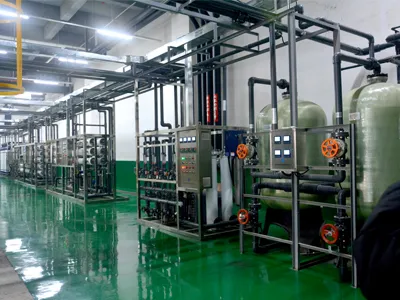
If there is pressure in the water after the circulation solenoid valve (for example, in UPH series ultrapure water systems, where the intermediate water tank is a constant pressure pure water tank), the lack of reverse water flow locking function in both pulse and household solenoid valves causes the substandard water after the circulation solenoid valve to mix with the compliant water after circulation, ultimately resulting in substandard water quality and failing to achieve the desired water quality optimization. Therefore, it is necessary to rectify and optimize the process flow to enable the circulation solenoid valve to reverse the water flow locking function.
If there is no water pressure after the circulation solenoid valve, the circulation solenoid valve may not have a reverse water-locking function. For example, in the UPHW series models, a pulse solenoid valve is used as the circulation solenoid valve. Because the raw water is drawn from the raw water tank by a self-priming pump, the water after the circulation solenoid valve is pressureless. At this time, the circulation solenoid valve is in the closed state, but it can still circulate normally and meet the water quality requirements.
This issue highlights the importance of a rigorous work attitude during both testing and trial phases. Applications should only be implemented after repeated comparative testing and verification to ensure accuracy. It also demonstrates that when facing unexpected problems, relevant personnel from various departments within our company can perform their duties effectively, cooperate efficiently, and promptly develop solutions to optimize and improve the process flow. Their dynamism and flexibility are commendable.





