

Phone:
0086 28 87573647
+86 19150187139

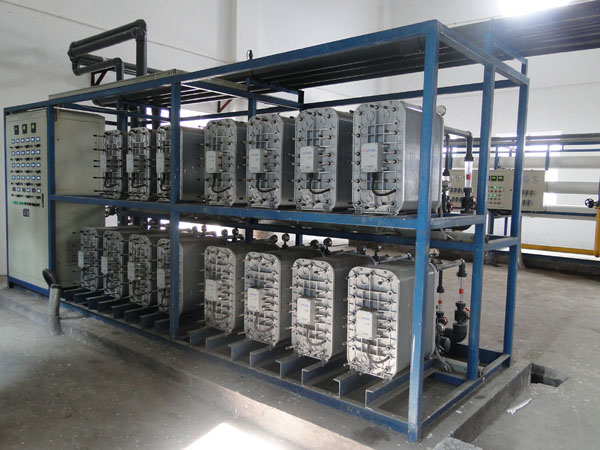
Ultrapure water purification processes can be broadly categorized into ion exchange, two-stage reverse osmosis, and EDI. Below, I will introduce the EDI method:
EDI is a novel desalination technology that organically combines electrodialysis and ion exchange technologies. It effectively removes all ions from water, achieving a stable effluent resistivity above 15 MΩ·cm. It operates continuously, is free of chemical pollution, and boasts high water utilization, making it a promising technology for high-purity water production. EDI ultrapure water treatment equipment is the optimal process for producing stable deionized water, used after the reverse osmosis system, replacing the traditional mixed ion exchange technology (MB-DI).
Working Principle:
1. Water enters the EDI system. The majority flows into the resin/membrane interior, while the remaining portion flows along the outer edge of the membrane to wash away ions that have permeated through the membrane.
2. The resin retains dissolved ions in the water.
3. Under the influence of the electrodes, anions move towards the positive electrode, and cations move towards the negative electrode.
4. Cations permeate through the cation exchange membrane and are discharged outside the resin/membrane.
5. Anions permeate through the anion exchange membrane and are discharged outside the resin/membrane.
6. Concentrated ions are discharged from the wastewater flow path.
7. Deionized water flows out from the resin/membrane.
TOC <0.5 mg/L Residual Chlorine <0.05 mg/L
Fe, Mn, H₂S <0.01 mg/L Inlet Pressure 30 - 100 PSI
Inlet Water Quality Requirements:
TEA (containing CO₂) <25 mg/LasCaCO₃ pH 5 - 9
Hardness <0.1 mg/LasCaCO₃ Silica <0.5 mg/L
EDI Advantages:
Stable water quality
Easy to achieve fully automatic control
No downtime due to regeneration
No need for chemical regeneration
Low operating costs
Small plant area
No wastewater discharge