





Phone:
0086 28 87573647
+86 19150187139

The following data was compiled by the Instrument Information Network (ISN) website of the China Association for Instrumentation Science and Technology. Clients can view it in the Market Research - Survey Report section of the Instrument Information Network.
Viewing address: http://www.instrument.com.cn/market/
Survey Leaders: Liao Qingling, Yang Juan
Survey Period: August 29, 2006 – October 31, 2006
Participants: All were VIP users of instrument.com, totaling 2026 people, from factories and mines (25.81% of the total surveyed), research institutions (including universities and colleges) (39.29%), testing organizations (19.64%), hospitals (1.28%), and other related units (13.97%).
Content: This survey investigated various aspects of the Chinese market for pure water purifiers, including market size, purchase time, mainstream brands and market share, instrument types, application areas, water sources and usage, satisfaction with instrument performance and quality, price, and after-sales service. The survey methods included online questionnaires and telephone interviews.
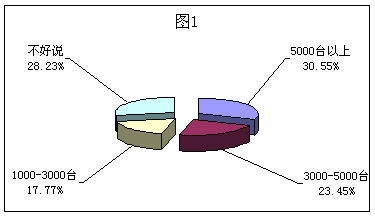
Laboratory pure water purifiers are essential instruments for water purification in scientific research and various application laboratories. Their wide range of applications implies a large market capacity. Regarding the annual sales volume in the Chinese market (see Figure 1), over 30% of respondents selected over 5000 units, approximately 20% selected 1000-3000 units and 3000-5000 units respectively, and nearly 30% were unsure. The survey results indicate a generally positive outlook on the sales of pure water purifiers.
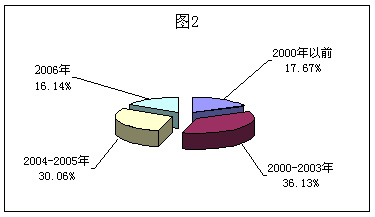
A survey on the purchase time of water purifiers shows (see Figure 2) that 18% of the total number of purchases were made before 2000; 36% were made between 2000 and 2003 (an average of 12.3% per year); 30% were made between 2004 and 2005; and 16% were made in the first half of 2006. These data indicate that water purifiers, as a common laboratory instrument, have seen their purchase rate reach half of the total in the past two years, with market demand and purchase rate maintaining a year-on-year upward trend.
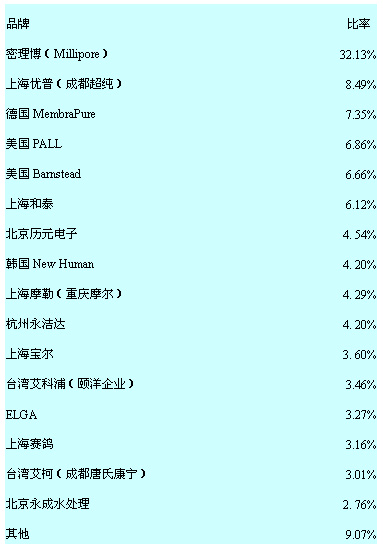
As a common instrument, there are numerous manufacturers of water purifiers. Millipore, the industry leader, maintained a commanding lead in this survey, with over 30% of respondents indicating they used Millipore products. It is reported that ten years ago, Millipore's brand share in the Chinese market once reached 90%. Brands such as Shanghai Ulupure (Chengdu Superpure), German Membrane, American Pall, American Barnstead, and Shanghai Hetai each had a market share between 5% and 10% in this survey. Beijing Liyuan Electronics, New Human (Korea), Shanghai Moller (Chongqing Moore), Hangzhou Yongjieda, Shanghai Baoer, Taiwan Aicopu, ELGA, Shanghai Saige, and Taiwan Aico (Chengdu Tangshi Kangning) each accounted for less than 5% of the market share in this survey. Approximately 10% of users chose other brands, including Sartorius, SG (Germany), Beijing Dongxi Electronics, Beijing Ying'an Meicheng, Beijing Zhongke Zhiheng, Jena (Germany), Ashura (USA), and Ovis (USA). (See table below) It seems that domestic water purifier users have gradually shifted from blindly pursuing imported instruments to prioritizing their needs and comparing both domestic and imported brands.
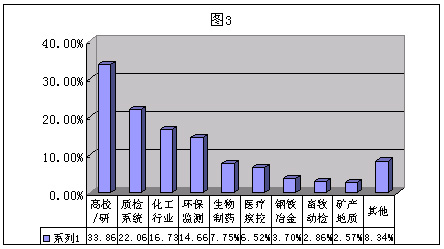
The survey results on the application fields of water purifiers show (as shown in Figure 3) that universities and research institutes rank first, with 34% of respondents indicating their use in this field, followed by quality inspection systems at 22%. The chemical industry and environmental monitoring fields also have wide applications of water purifiers, each accounting for approximately 15%. The biopharmaceutical and medical disease control fields each account for about 7% of the total. Following these are the iron and steel metallurgy, animal inspection and quarantine in the livestock industry, and mineral geology, each accounting for about 3%. Approximately 8.21% of respondents indicated that they use water purifiers in other fields, as shown in the figure below.
Water purification methods can be divided into: distillation, ion exchange, activated carbon adsorption, microfiltration, ultrafiltration, ultraviolet irradiation, electrodialysis (EDI), and reverse osmosis (RO), etc. Ion exchange involves filtering raw water with spherical resin (ion exchange resin), where ions in the water exchange with ions fixed on the resin. The two most common ion exchange methods are water softening and deionization. Water softening is primarily a pretreatment process used before reverse osmosis (RO) to reduce water hardness. Activated carbon adsorption removes non-ionic organic matter by utilizing the pore size of activated carbon filters and the permeation of organic matter through these pores; activated carbon filters are typically installed before ion exchange resins. Microfiltration is generally placed at the final point of use in purification systems to remove residual trace amounts of resin debris, carbon deposits, colloidal particles, and microorganisms. Reverse osmosis (RO) is the most economical method, achieving 90%–99% impurity removal rates, and is typically used to filter contaminants with a diameter less than 1 nm. Key indicators for pure water quality monitoring include: conductivity/resistivity (κ), total organic carbon level, pH value, pyrogen level, and microbial content.
This survey of pure water purifier types was conducted based on instrument technical specifications and application fields, categorizing them as follows for selection: Conventional physicochemical analysis type, suitable for routine chemical analysis, qualitative analysis, buffer solution preparation, etc.; Ultra-low TOC type, with ultra-low organic matter, suitable for high-performance liquid chromatography, ion chromatography, gas chromatography, gas chromatography-mass spectrometry, total organic carbon (TOC) analysis, organic matter analysis, capillary electrophoresis, microelectronic component washing, toxicology research, environmental experimental analysis, etc.; Pyrogen removal type, removing pyrogens (endotoxins), used in liquid/gas chromatography, amino acid analysis, protein purification, electrophoresis/gel analysis, toxicology research, animal and plant cell culture, tissue culture, in vitro fertilization, molecular biology experiments, etc.; Both ultra-low TOC and pyrogen removal type, removing both organic matter and endotoxins, suitable for microbial culture medium preparation, environmental analysis experiments, physical electrochemistry and interface research, various high-precision instrument analysis, molecular biology and life sciences, in vitro fertilization, tissue culture, animal and plant cell culture, amino acid analysis, two-dimensional electrophoresis, etc. Basic application type, suitable for high-performance liquid chromatography, ion chromatography, atomic absorption and emission spectroscopy, mass spectrometry, amino acid analyzers, PCR applications and analysis, gas chromatography instruments, high-precision optical lens washing, preparation and dilution of analytical reagents and chemicals, and water for precision instrument analysis.
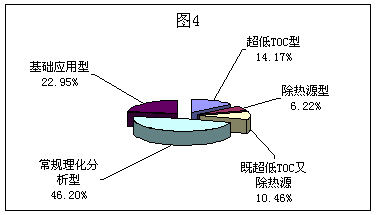
A survey on the use of different types of water purifiers (Figure 4) shows that the conventional physicochemical analysis type is the most common, accounting for nearly half; the basic application type ranks second with over 20% market share; the ultra-low TOC type ranks third with 15%; followed by the ultra-low TOC and pyrogen removal type, accounting for about 10%; and the pyrogen removal type ranks last with less than 10%.
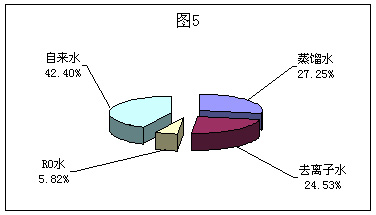
Regarding the water source for water purifiers (Figure 5), over 40% of respondents indicated that they directly purified tap water using a water purifier, followed by distilled water and deionized water purified by the water purifier. Less than 10% of respondents indicated that they used RO water (reverse osmosis water) purified by the water purifier for related applications.
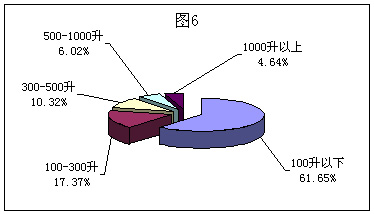
The survey results regarding daily water consumption (Figure 6) show that over 60% of respondents use less than 100 liters per day, 17% use 100-300 liters, 10% use 300-500 liters, and relatively few use 500-1000 liters or even more than 1000 liters: approximately 6% use the former and 5% use the latter.
The survey results regarding satisfaction with the water quality of the water purifier are quite encouraging, with approximately 46% of users expressing satisfaction, 51% expressing neutrality, and only 3% expressing dissatisfaction. Regarding the ease of use of the system, 58% of users found it convenient, 32% found it neutral, and only 10% found it inconvenient. Regarding after-sales service satisfaction, 33% of users expressed satisfaction, 60% expressed neutrality, and 7% expressed dissatisfaction. Regarding supplier consumable prices satisfaction, 22% of users expressed satisfaction, 62% expressed neutrality, and 16% expressed dissatisfaction. The survey above shows that users are generally satisfied with the water quality, ease of use, after-sales service, and consumable prices of existing water purifiers. Of course, manufacturers would be better off focusing on improving ease of use and reducing consumable prices to better meet user needs.
In this survey, 18% of users indicated that their organizations or departments plan to purchase water purifiers in the near future, while 82% indicated that they do not currently plan to purchase any. This data suggests that the domestic market demand for water purifiers is still quite significant.





