

Phone:
0086 28 87573647
+86 19150187139

I. Comparison of EDI Units and Mixed-Bed Ion Exchange Equipment
EDI units and mixed-bed ion exchange equipment are both fine treatment devices in water treatment systems. The following comparison of the two types of equipment in terms of product water quality, investment, and operating costs illustrates the advantages of EDI units in water treatment.
(1) Product Water Quality Comparison
EDI units operate on a continuous water purification process, resulting in stable product water quality. The resistivity is typically 15 MΩ·cm, with a maximum of 18 MΩ·cm, meeting ultrapure water standards. Mixed-bed ion exchange facilities operate intermittently. The product water quality is higher immediately after regeneration and lower before the next regeneration.
(2) Investment Comparison
The investment in EDI units is approximately 20% higher than that of mixed-bed ion exchange facilities. However, considering the need for acid and alkali storage, acid and alkali addition, wastewater treatment facilities, and subsequent maintenance and resin replacement, the cost difference is only about 10%. With technological advancements and mass production, the investment required for EDI units will significantly decrease. Furthermore, EDI equipment is compact, requiring far less plant space than mixed bed systems.
(3) Comparison of Operating Costs
EDI operating costs include electricity consumption, water consumption, reagent costs, and equipment depreciation, eliminating the costs associated with acid/alkali consumption, regeneration water, wastewater treatment, and sewage discharge.
Regarding electricity consumption, EDI consumes approximately 0.5 kWh/t of water, while mixed bed systems consume approximately 0.35 kWh/t of water. The electricity cost is relatively economical for power plants and can be calculated using the price of plant-use electricity.
Regarding water consumption, EDI systems have a high water production rate and do not require regeneration water, thus their operating costs in this aspect are lower than those of mixed beds.
The difference in reagent costs and equipment depreciation costs is not significant.
In summary, the operating cost per ton of water for EDI systems is approximately RMB 2.4, while the operating cost per ton of water for conventional mixed beds is approximately RMB 2.7, higher than that of EDI systems. Therefore, the additional investment in EDI systems can be fully recovered within a few years.
II. Applications of EDI Technology
EDI technology has been widely used abroad for over a decade, primarily in the pharmaceutical, microelectronics, power generation, and laboratory industries. Its applications in surface cleaning, surface coating, electrolysis, and chemical industries are also increasingly widespread. In my country, its application has only been around for 2-3 years, mainly for ultrapure water treatment in the pharmaceutical and microelectronics industries, while its application in chemical water treatment systems in the power generation industry is just emerging.
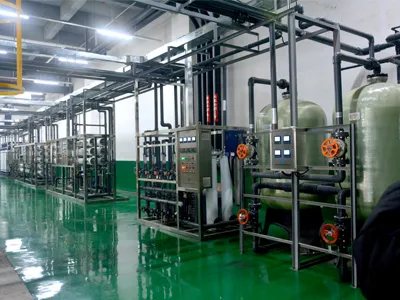
Currently, some thermal power plants in Shandong Province have adopted EDI technology to treat boiler feedwater. This system mainly includes a dosing system, a multi-media filter, an activated carbon filter, reverse osmosis, and EDI equipment. The treatment capacity is 160 t/h. It was put into operation during the winter heating season of 2000 and has been running well. The second phase (150 t/h) project is currently under installation, and both phases will be fully operational during the winter heating season of this year.
III. Conclusion
EDI equipment is a type of water purification equipment with advantages such as continuous water production, high water quality, easy control, small footprint, no need for acid or alkali treatment, and environmental friendliness, making it a promising technology with broad application prospects. With equipment improvements, technological advancements, and optimization for different industries, initial investment costs will be significantly reduced. It is reasonable to believe that in the near future, it will completely replace traditional mixed ion exchange equipment in water treatment processes.