


Phone:
0086 28 87573647
+86 19150187139
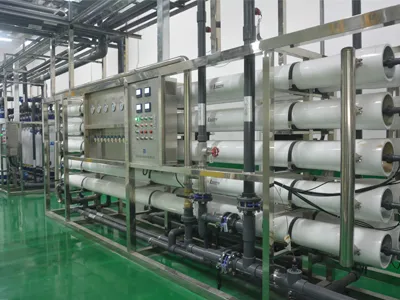
RO membranes are crucial for ultrapure water systems. If an RO membrane breaks, it directly impacts the water produced. So, what causes RO membrane breakage in ultrapure water systems?
Excess gas remaining in the RO reverse osmosis membrane unit, running rapidly under high pressure, can cause air hammer, damaging the RO membrane. Firstly, after the gas is purged, the pressure will gradually increase during restart. Therefore, it's essential to maintain a pressure of 2-4 bar to purge excess air before gradually increasing. Secondly, if the pump and the system are not properly sealed, air can be drawn in through the vacuum. Therefore, the microfilter should be replaced promptly to ensure leak-free piping.
Incorrect shutdown procedures for the RO reverse osmosis membrane equipment. Once the unit stops operating normally, a certain amount of additive needs to be added to reduce the pressure until the TDS (Total Dissolved Solids) is close to normal.
Inadequate sterilization of the RO reverse osmosis membrane equipment can lead to excessive microbial contamination.
The pressure applied during the RO reverse osmosis process, within the limits allowed by the RO reverse osmosis membrane system and membrane strength, must be significantly greater than the solution osmotic pressure, typically several to tens of times higher. When the salt solution comes into contact with the porous semi-permeable membrane surface, a layer of water molecules is selectively adsorbed at the membrane-solution interface. Under the pressure of the RO reverse osmosis membrane, pure water flows out through the membrane's capillary action, continuously forming an interfacial pure water layer.
This concludes our explanation of the causes of RO membrane breakage in ultrapure water systems. We hope this information is helpful. Regular maintenance and inspection of ultrapure water systems are essential to ensure their proper operation.